
PM Surya Ghar Solar Loan Rejections: Causes, District Magistrate Directives, and Step-by-Step Approval Solutions
FreeSolar Banking & Regulatory Desk · 08 Oct 2026 · 6 min read
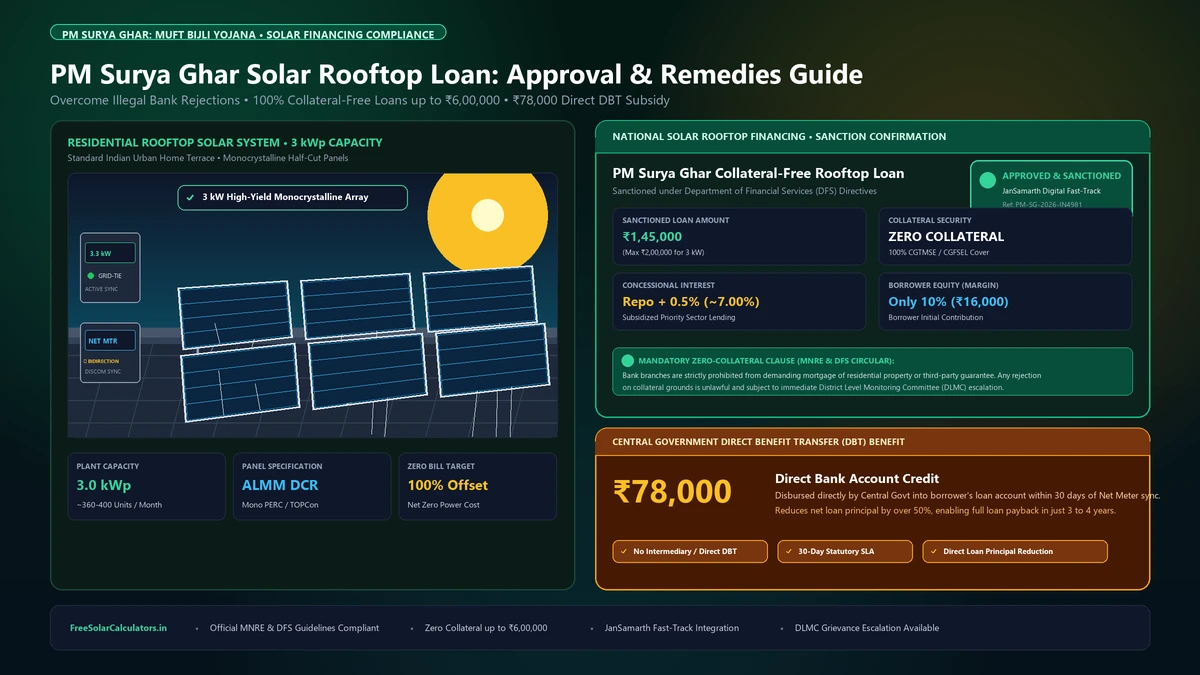
Model monthly EMI, concessional interest rates (~7%), and zero-collateral bank loan tenures under PM Surya Ghar.
The rollout of the PM Surya Ghar: Muft Bijli Yojana represents one of the most ambitious renewable energy saturation initiatives ever undertaken globally. With a national mandate to empower 1 Crore (10 million) Indian households with grid-connected rooftop solar systems, the scheme promises up to 300 units of free electricity every month and a direct bank transfer (DBT) central subsidy of up to ₹78,000.
Yet, across thousands of towns and rural districts in India, eager applicants are encountering an unexpected administrative wall: commercial banks and Regional Rural Banks (RRBs) dragging their feet, keeping files pending for months, or outright rejecting valid solar loan applications.
While consumer registrations on the National Portal (pmsuryaghar.gov.in) have crossed historic highs, loan conversion rates at the branch level continue to lag behind targets. This widening rift between national policy intent and grassroots financial execution has reached a tipping point, forcing district administrative chiefs to step in directly.
1. Administrative Crackdown: Why District Magistrates Are Intervening
A stark manifestation of this ground-level friction occurred recently in Bihar, where District Magistrate (DM) Abhishek Ranjan and Deputy Development Commissioner (DDC) Arun Kumar convened a high-stakes emergency review at the Jhallu Babu Auditorium within the DRDA campus in Madhepura.
Facing a massive backlog of pending solar loan applications submitted through the JanSamarth and PM Surya Ghar portals, the district administration summoned branch managers from all public sector commercial banks, regional rural banks, and private lenders, alongside executive engineers from the state electricity distribution utilities (NBPDCL and SBPDCL).
The message from the District Magistrate was clear and uncompromising:
- Zero Tolerance for Unjustified Rejections: Banks cannot summarily dismiss solar applications on flimsy, informal pretexts or verbal refusals. Every rejection must carry a documented, verifiable statutory reason.
- Elimination of Pendency Backlogs: Branch managers were ordered to clear all pending document verifications within strict, time-bound deadlines.
- 100% Target-Driven Saturation: The district administration mandated synchronized coordination between electricity department engineers (responsible for distribution transformer feasibility and net metering) and bank credit officers to achieve complete installation targets.
Administrative Hierarchy for PM Surya Ghar Oversight:
District Level Monitoring Committee (DLMC) -> Headed by District Magistrate (DM)
  ├── Lead District Manager (LDM) -> Coordinates all Commercial Banks & RRBs
  ├── DISCOM Executive Engineers -> Oversees 11 kV Feeder & Transformer Feasibility
  └── Empaneled Solar Vendors -> Ensures Physical Installation & Net-Meter Setup
Similar administrative reviews are now unfolding across districts in Uttar Pradesh, Rajasthan, Madhya Pradesh, and Odisha. District Magistrates head the District Level Monitoring Committee (DLMC) for renewable energy. When national saturation targets stall because individual branch managers sit on files, District Magistrates possess the statutory authority to escalate non-compliance directly to the State Level Bankers' Committee (SLBC) and the Department of Financial Services (DFS) under the Ministry of Finance.
2. The Banker's Dilemma: 1 Crore Solar Target vs NPA Fear and Audit Scrutiny
To resolve a loan rejection, one must first understand why bank branch managers are reluctant to sanction PM Surya Ghar loans, despite intense pressure from the central government and district collectors.
At the branch level, loan officers face a structural conflict of interest between policy targets and credit risk liability:
A. The Fear of Non-Performing Assets (NPAs)
Branch managers in India operate under the constant scrutiny of Asset Quality Reviews (AQR). Public sector banks and Regional Rural Banks have endured painful decades dealing with elevated NPAs in unsecured priority sector lending, particularly agricultural Kisan Credit Cards (KCC) and micro-enterprise loans under the Mudra scheme. When an unsecured or thinly secured loan defaults for more than 90 days, it is classified as a Non-Performing Asset, directly impairing the branch's profitability and capital adequacy.
B. The Rooftop Asset Liquidation Problem
In conventional home loans, auto loans, or gold loans, the bank holds a tangible, readily liquidable security. If a borrower defaults on a home loan, the bank invokes the SARFAESI Act to seize and auction the immovable property. If an auto loan turns bad, the vehicle can be repossessed by recovery agents.
Solar rooftop plants, however, are installed 30 feet above the ground on private residential roofs. If a homeowner stops paying their solar EMI:
- How does a bank branch repossess second-hand solar panels bolted onto an individual's private terrace?
- Even if dismantled, what is the resale recovery value of aged, customized solar mounting structures and inverters?
- Who pays for the labor, de-installation costs, and storage logistics?
Because rooftop solar equipment has negligible secondary liquidation value for a recovery officer, branch managers perceive these loans as virtually 100% unsecured personal exposure.
C. Statutory Internal Audit and Vigilance Scrutiny
In state-owned banking institutions, if an uncollateralized loan defaults, the sanctioning branch manager is subjected to internal vigilance inspections and statutory audit queries. Officers are required to prove that every single document, credit verification, and physical inspection was conducted without the slightest procedural flaw. Fearing future charge-sheets or loss of promotion opportunities, many branch managers adopt a defensive posture: it feels safer for their career to reject or stall ten applications than to sanction one loan that might turn into an NPA three years down the line.
3. Top 6 Reasons Banks Reject PM Surya Ghar Loan Applications (and How to Fix Each)
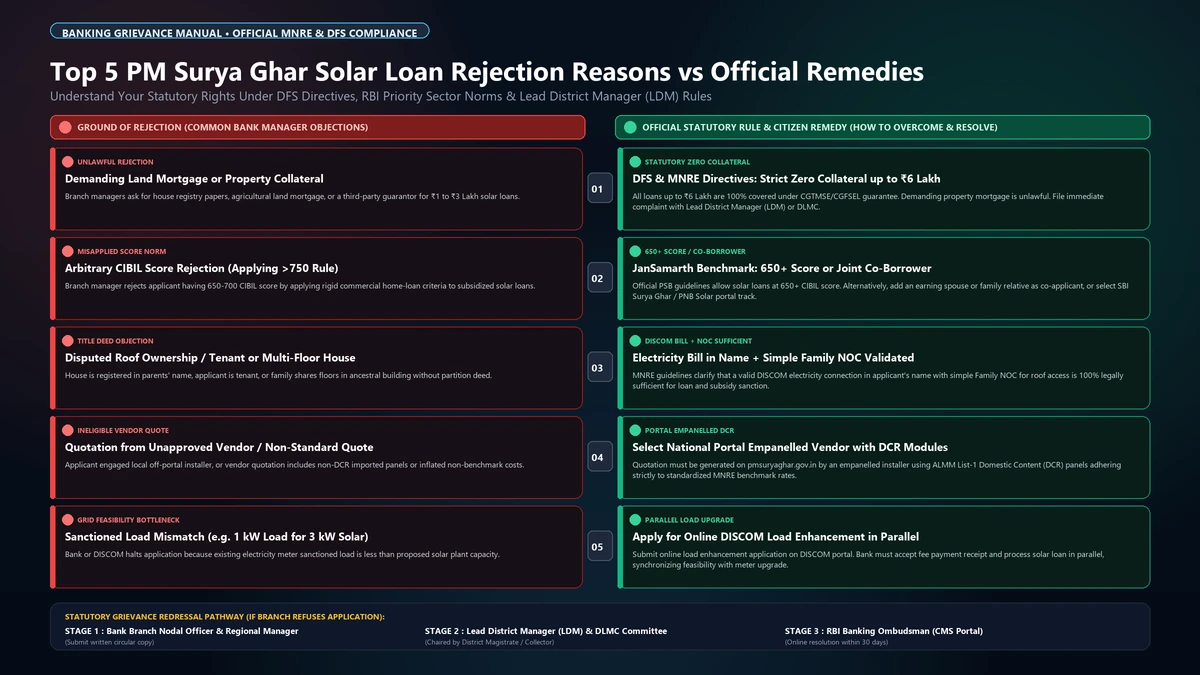
While bank officers harbor systemic anxieties, official rejections must be grounded in specific procedural or credit parameters. Here are the six most common grounds on which PM Surya Ghar loan applications are rejected, along with proven, practical solutions to overcome each hurdle.
Common Loan Rejection Drivers in India:
1. Credit Score Flaws (<650 CIBIL / Past Settlements)         [34%]
2. Name Mismatch (Electricity Bill vs Bank KYC / Registry)   [26%]
3. Income Documentation Gaps for Non-Salaried Applicants    [18%]
4. DISCOM Technical Feasibility Delays / Unregistered Vendor  [12%]
5. Roof Rights & Structural Ambiguity                        [6%]
6. Branch-Level Quota Exhaustion & Verbal Refusals           [4%]
Reason 1: CIBIL Score Below 650 or Adverse Credit Remarks
- The Root Problem: Digital platforms like the JanSamarth portal run automated credit checks across CIBIL, Experian, or Equifax. If your credit score is below 650, or if your report reflects a past loan 'Settlement', 'Written-Off' credit card balance, or recent 90-day overdue payments on consumer durable loans, the underwriting algorithm issues an automated credit rejection.
- The Fix:
- Add a Creditworthy Co-Applicant: If your CIBIL score is weak, add your spouse, employed son, or daughter with a clean credit history (700+) as a joint borrower. Public sector banks actively accept blood-relation co-borrowers for domestic rooftop solar financing.
- Clear Outstanding Dues & Obtain No-Dues Certificates (NDC): Settle disputed micro-loans or credit card balances and insist that the lender update CIBIL records within 30 days.
- Apply Manual Credit Appraisal: For scores between 650 and 680, request the branch manager to process the application under manual credit discretion, highlighting that your electricity bill savings will directly fund the EMI.
Reason 2: Discrepancy Between Electricity Connection Name and Property Ownership
- The Root Problem: In multi-generational Indian families, electricity meters often remain registered in the name of a deceased grandfather or late father, while the applicant applying for the loan is the son or grandson. When the name on the electricity bill does not match the applicant's Aadhaar card and bank account KYC, automated portal validation fails.
- The Fix:
- Immediate Name Transfer on DISCOM Portal: In states like Bihar, applications for change of consumer name can be completed swiftly via the DISCOM mobile app (such as the Suvidha App for NBPDCL/SBPDCL) by submitting a death certificate and succession declaration.
- Family Consent Affidavit: If name transfer is pending, submit a notarized No-Objection Certificate (NOC) and family genealogical tree (Vanshavali) signed by all legal heirs confirming that the applicant holds lawful possession of the premises and rooftop.
Reason 3: Incomplete Feasibility Approval or Unapproved Solar Vendor
- The Root Problem: Bank loan disbursement is legally contingent on successful technical feasibility approval from your local power distribution company (DISCOM) and selection of an empaneled vendor. If your chosen vendor has let their bank guarantee lapse or is not registered on the national PM Surya Ghar portal for your specific distribution circle, the bank cannot link the vendor's escrow account.
- The Fix:
- Choose Portal-Empaneled Vendors Only: Verify that your installer is listed as an active, verified vendor on
pmsuryaghar.gov.inwith active status in your district. - Track Technical Feasibility: Ensure the local Junior Engineer (JE) of your electrical subdivision has approved transformer capacity before submitting the loan file to the bank.
- Choose Portal-Empaneled Vendors Only: Verify that your installer is listed as an active, verified vendor on
Reason 4: Unsubstantiated or Irregular Income for Non-Salaried Applicants
- The Root Problem: Rural artisans, farmers, small shopkeepers, and informal workers often do not possess formal salary slips, Form 16, or filed Income Tax Returns (ITR). Traditional loan underwriters often default to rejecting applications lacking standard income proofs.
- The Fix:
- Submit Alternative Cash-Flow Evidence: Provide 12 months of savings bank statements reflecting steady turnover, agricultural land ownership records (Khatian / Jamabandi / 7/12 extract), or GST returns if running a commercial enterprise.
- Demonstrate Expense Replacement: Emphasize to the branch manager that a 3 kW solar plant replaces a recurring monthly electricity bill of ₹2,500 to ₹3,000. Because the borrower is already paying this sum every month to the electricity department, redirecting that cash flow toward a ₹1,750 EMI creates zero additional financial burden.
Reason 5: Unapproved Roof Type or Lack of Clear Physical Roof Access
- The Root Problem: Banks require the installation site to be permanent and durable for the 25-year design life of the solar system. If the roof consists of temporary tin sheets, asbestos panels, or lacks permanent staircase access, credit officers may reject the proposal during mandatory pre-sanction site inspections.
- The Fix:
- Reinforced Mounting Certification: For industrial-grade tin sheet roofs, submit a structural stability certificate signed by a chartered civil engineer confirming load-bearing capacity.
- Clear RCC Roof Partition: On shared family roofs, clearly demarcate the specific terrace footprint allocated for the solar arrays, supported by an internal family partition agreement and clear photographs showing unhindered staircase access.
Reason 6: Arbitrary Branch-Level Fatigue and Quota Exhaustion Claims
- The Root Problem: Branch managers often give oral brush-offs, telling customers: "Hamari branch ka solar target khatam ho gaya hai" (Our branch has fulfilled its solar quota) or "Abhi rooftop loan band hai" (Rooftop loans are temporarily paused).
- The Fix:
- Insist on Written Communication: Never accept a verbal refusal. Under the Reserve Bank of India's Fair Practices Code, every bank is legally mandated to provide a written acknowledgment and a formal rejection memo detailing specific regulatory grounds for refusal.
- Cite Central Guidelines: Inform the branch officer that under the Ministry of New and Renewable Energy (MNRE) mandate, public sector banks do not have restrictive district branch quotas that permit refusing eligible domestic citizens.
4. Official RBI & MNRE Guidelines: Collateral-Free Loans and Interest Rate Caps
Many applicants do not realize that the Reserve Bank of India (RBI) and the Ministry of New and Renewable Energy (MNRE) have established binding regulatory frameworks to protect domestic rooftop solar borrowers.
Key RBI & MNRE Lending Norms at a Glance:
┌──────────────────────────────┬────────────────────────────────────────────────────────┐
│ Regulatory Parameter         │ Official Guideline / Statutory Ceiling                 │
├──────────────────────────────┼────────────────────────────────────────────────────────┤
│ Priority Sector Status       │ Mandated under RBI Master Directions (Renewable Energy)│
│ Collateral Security          │ ZERO Collateral up to ₹2 Lakh / Asset Hypothecation    │
│ Third-Party Guarantee        │ Waived for standard residential applications           │
│ Interest Rate Ceiling        │ Repo Rate + 1.50% (Currently ~8.00% to 8.50%)          │
│ Maximum System Financing     │ Up to 90% of Total Turnkey Project Cost               │
│ Minimum Margin Money         │ Only 10% required from consumer                        │
│ Maximum Repayment Tenure     │ Up to 120 Months (10 Years)                            │
│ Subsidy DBT Treatment        │ Automatically credited to principal loan account       │
└──────────────────────────────┴────────────────────────────────────────────────────────┘
Priority Sector Lending (PSL) Mandate
Under the RBI Master Directions on Priority Sector Lending (FIDD.CO.Plan.BC.5/04.09.01/2020-21), bank loans up to ₹10 Lakh per borrower for renewable energy installations—including residential rooftop solar systems—are explicitly classified as Priority Sector Lending. Public sector banks and private commercial banks must fulfill mandatory PSL targets; refusing eligible rooftop solar borrowers directly jeopardizes their regulatory compliance.
The Collateral-Free Protection
- Loans up to ₹2 Lakh: For standard residential systems (up to 3 kW capacity), banks are strictly prohibited from demanding collateral security such as house registration deeds, agricultural land mortgages, or fixed deposit liens. The only security permitted is the hypothecation of the solar equipment being funded.
- Loans between ₹2 Lakh and ₹6 Lakh: For larger residential installations (up to 10 kW capacity), banks finance up to 90% of project costs against asset hypothecation, without demanding mortgage of residential real estate.
Concessional Repo-Linked Interest Rates
Under the special PM Surya Ghar financing scheme rolled out across major scheduled commercial banks (including State Bank of India, Punjab National Bank, Canara Bank, and Bank of Baroda):
- Systems up to 3 kW: The interest rate is strictly capped at Repo Rate + 1.50%. With the prevailing RBI Repo Rate at 6.50%, the effective borrowing rate stands between 8.00% and 8.15% per annum.
- Systems above 3 kW up to 10 kW: Capped at Repo Rate + 2.50% to 3.00% (approx. 9.00% to 9.50% per annum).
Banks cannot charge exorbitant personal loan rates (14% to 18%) for rooftop solar installations sanctioned under the national portal scheme.
5. What to Do If Your Loan Is Rejected or Delayed: The Step-by-Step Escalation Matrix
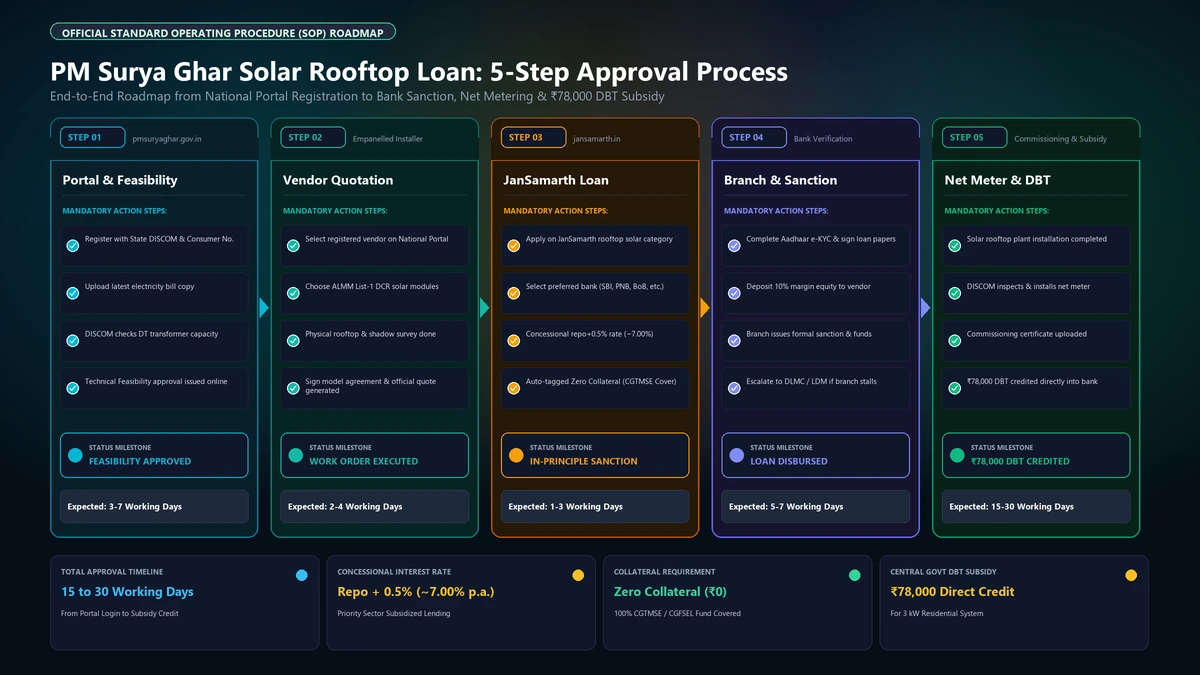
If your solar loan application has stalled or been unfairly rejected, do not abandon your project. Follow this battle-tested, hierarchical escalation matrix to compel prompt regulatory action:
Step-by-Step Grievance Escalation Hierarchy:
Tier 1: Branch Manager Formal Written Submission (Demand Reason for Denial)
   │ (Wait 7 Working Days)
   ▼
Tier 2: Lead District Manager (LDM) & District Collectorate (DLMC / DM Office)
   │ (Wait 7 Working Days)
   ▼
Tier 3: JanSamarth Grievance Portal & State Level Bankers' Committee (SLBC)
   │ (Wait 15 Working Days)
   ▼
Tier 4: RBI Integrated Banking Ombudsman (cms.rbi.org.in)
Tier 1: Formal Written Representation to the Branch Manager
Visit the branch and deliver a formal, signed representation letter addressed to the Branch Manager.
- Cite your PM Surya Ghar Application ID and JanSamarth Reference Number.
- Quote the RBI Master Directions on Priority Sector Lending.
- Respectfully request in writing: "Kindly sanction the application as per MNRE collateral-free guidelines, or provide a formal written rejection memorandum stating the specific grounds of ineligibility within 7 working days."
- Always obtain a receiving stamp and signature on your photocopy. Branch managers often approve stalled files immediately when an applicant creates an auditable paper trail.
Tier 2: Approach the Lead District Manager (LDM) and District Magistrate
Every district in India has a designated Lead District Manager (LDM), usually an experienced Chief Manager representing the lead public sector bank of that district.
- Submit a copy of your acknowledged representation letter to the LDM office.
- Submit a parallel copy to the District Collectorate (Confidential Section / District Planning Officer) addressed to the District Magistrate as Chairman of the District Level Monitoring Committee (DLMC).
- As demonstrated by District Magistrate Abhishek Ranjan in Madhepura, District Magistrates actively summon branch managers during weekly review meetings to resolve these pending files under threat of disciplinary escalation.
Tier 3: Escalate to JanSamarth Portal Grievance and SLBC
- Log in to the JanSamarth Portal (
jansamarth.in) using your credentials, navigate to the Grievance Redressal tab, and lodge a ticket against the specific branch code, attaching your rejection slip or screenshot of pendency. - Send an email detailing the branch's refusal to the SLBC Convenor Bank of your state (e.g., State Bank of India in Bihar and Maharashtra, Punjab National Bank in Haryana).
Tier 4: File a Complaint with the RBI Integrated Banking Ombudsman
If the bank fails to resolve the issue within 30 days or rejects your application without valid statutory cause, file a formal complaint online via the RBI Complaint Management System (CMS) at cms.rbi.org.in.
- Select category: Non-observance of Reserve Bank directives / Deficiency in banking services / Priority Sector Lending non-compliance.
- Banks face severe regulatory penalties and adverse audit entries from the Banking Ombudsman for arbitrary refusals of priority sector mandates.
6. Financial Case Study & EMI Math: 3 kW System Cash-Flow Analysis
The most persuasive argument to satisfy both your family budget and your bank branch manager is the underlying financial cash flow of a rooftop solar installation.
When structured properly, a PM Surya Ghar loan is completely self-funding from Month 1, generating immediate net cash savings rather than an expenditure burden.
Monthly Cash Flow: 3 kW Rooftop Solar System in India
┌───────────────────────────────────────────────┬────────────────────────┐
│ Financial Parameter                           │ Value in Indian Rupees │
├───────────────────────────────────────────────┼────────────────────────┤
│ Total Turnkey Capital Cost (3 kW On-Grid)     │ ₹1,45,000              │
│ Central Government DBT Subsidy (Credited Bank)│ -₹78,000               │
│ True Net Out-of-Pocket Cost                   │ ₹67,000                │
├───────────────────────────────────────────────┼────────────────────────┤
│ Initial Consumer Margin Paid (10%)            │ ₹14,500                │
│ Bank Loan Disbursed (90%)                     │ ₹1,30,500              │
│ Residual Principal Loan (After Subsidy Credit)│ ₹52,500                │
├───────────────────────────────────────────────┼────────────────────────┤
│ Monthly Bank EMI (36 Months @ 8.15% p.a.)     │ ₹1,750 / month         │
│ Monthly Electricity Bill Savings (380 Units)  │ ₹2,800 / month         │
├───────────────────────────────────────────────┼────────────────────────┤
│ Net Monthly Profit in Your Pocket (Month 1)   │ +₹1,050 / month        │
│ Total Free Electricity Post Loan Clearance    │ 22 Full Years          │
│ Estimated 25-Year Cumulative Savings          │ ₹8,50,000+             │
└───────────────────────────────────────────────┴────────────────────────┘
The Mathematics of a Self-Funding Asset
- Initial Project Commissioning: A premier 3 kW mono-PERC or TOPCon system costs approximately ₹1,45,000 turnkey (including panels, high-efficiency grid-tied inverter, lightning arresters, earthing kits, and bi-directional meter installation).
- Financing Structure: The bank disburses ₹1,30,500 (90%), while the homeowner pays an initial margin of ₹14,500 (10%).
- Subsidy Debt Liquidation: Within 30 to 45 days of commissioning and net-meter synchronization, the Ministry of New and Renewable Energy credits the ₹78,000 DBT subsidy directly into the linked loan account.
- Residual Principal Balance: The outstanding loan principal drops instantly from ₹1,30,500 down to just ₹52,500.
- The EMI vs Savings Equation:
- Amortizing the remaining ₹52,500 balance over a 3-year term (36 months) at an interest rate of 8.15% results in a monthly EMI of approx. ₹1,750.
- A well-engineered 3 kW system in sunny regions like Bihar, Rajasthan, or Gujarat generates 360 to 420 units (kWh) of clean electricity every month.
- At an average domestic tariff of ₹7.00 to ₹7.50 per unit, your monthly electricity bill drops by ₹2,600 to ₹2,850 every single month.
- Subtracting your monthly EMI of ₹1,750 from your bill savings of ₹2,800 yields a net monthly cash surplus of ₹1,050 in your pocket from the very first month.
After just 36 months, the bank loan is 100% repaid. For the remaining 22 years of panel warrantied performance, every single unit of solar power generated from your roof is 100% free electricity.
7. Plan Your System with FreeSolarCalculators Tools
Before approaching your local bank branch, arm yourself with precise, engineer-verified solar estimations to demonstrate creditworthiness and technical viability:
- Calculate Bihar State Solar Potential: If you reside in North or South Bihar, run your exact electricity consumption through our dedicated Bihar Solar Calculator to evaluate state-specific tariffs, solar insolation, and localized Discom net metering guidelines.
- Verify Your Subsidy Eligibility: Check exact Central Financial Assistance (CFA) amounts for 1 kW, 2 kW, 3 kW, or higher domestic loads using the PM Surya Ghar Subsidy Calculator.
- Simulate Accurate Bank EMIs: Calculate exact monthly installments, interest rates, and loan tenure across major Indian public sector banks using our interactive Solar Loan EMI Calculator.
By presenting verified generation estimates and cash-flow projections during your bank interview, you eliminate credit ambiguity, dismantle branch resistance, and accelerate your path to zero electricity bills.
Calculate your own numbers
Model your rooftop capacity, subsidy eligibility, and payback periods using our specialized calculators.
Solar Loan EMI Calculator India: Interest & Repayment
Model monthly EMI, concessional interest rates (~7%), and zero-collateral bank loan tenures under PM Surya Ghar.
Solar Quote Checker India: Compare Installation Costs
Verify solar installer quotations against official MNRE benchmark rates and component quality standards.
Solar ROI Calculator India: Return & Payback Period
Simulate your exact payback period (typically 3.2 to 4.2 years) and 25-year cumulative wealth creation.
Frequently asked questions
Can a bank demand my house registry or agricultural land papers as collateral for a PM Surya Ghar loan?
No. Under the Reserve Bank of India (RBI) Priority Sector Lending guidelines and MNRE operational rules, bank loans up to ₹2 Lakh for residential rooftop solar are 100% collateral-free. The bank is strictly prohibited from demanding house deeds, land papers, or fixed deposits. The only security permitted is the hypothecation of the solar panels and inverter equipment installed on your roof.
What should I do if the bank branch manager verbally claims their solar loan quota is exhausted?
Never accept a verbal refusal. Under the RBI Fair Practices Code, every bank is legally required to give a written reason for denying a loan. Submit a written representation quoting your JanSamarth reference number and request a formal rejection memorandum. If the branch refuses, escalate the matter to the Lead District Manager (LDM) and the District Magistrate (DM) who heads the District Level Monitoring Committee.
How is the ₹78,000 PM Surya Ghar subsidy adjusted against my bank loan?
When you finance a solar installation through the JanSamarth portal, your bank loan account is linked to the national portal. Once installation and net metering inspection are completed, the Ministry of New and Renewable Energy deposits the ₹78,000 DBT subsidy directly into your bank loan account, instantly reducing your principal debt and lowering your monthly EMI.
What is the minimum CIBIL credit score required for PM Surya Ghar solar loan approval?
Most public sector banks prefer a CIBIL score of 680 and above for automated approval on the JanSamarth portal. However, scores between 650 and 680 can be sanctioned under manual branch underwriter discretion. If your score is below 650, adding an employed spouse or family member with a clean credit history as a co-applicant resolves the issue.
Can rural applicants without formal salary slips or ITR get a solar loan from Gramin Banks?
Yes. Regional Rural Banks (RRBs) and public sector banks are mandated to finance rural applicants under Priority Sector Lending norms. Non-salaried applicants can establish creditworthiness by submitting 12 months of active bank savings statements, land ownership revenue records (such as Khatian or Jamabandi), and demonstrating that the solar EMI simply replaces their existing monthly electricity expenditure.
How can I lodge an official regulatory complaint if a bank unfairly delays or rejects my solar loan?
First, submit a written complaint to the branch manager and obtain an acknowledgment stamp. If unresolved after 7 days, submit copies to the Lead District Manager (LDM) and the District Magistrate's office. Simultaneously, register an online grievance on the JanSamarth portal. If the bank fails to provide relief within 30 days, file a formal complaint with the RBI Integrated Banking Ombudsman at cms.rbi.org.in.
This technical guide is authored and audited against current Ministry of New & Renewable Energy (MNRE) guidelines, the National Portal for Rooftop Solar (pmsuryaghar.gov.in), Bureau of Indian Standards (BIS), and State Electricity Regulatory Commission (SERC) tariff schedules.
Disclaimer: Solar generation, net metering credits, and financial savings depend on local irradiation, terrace azimuth, and specific DISCOM net-metering regulations.
Related posts
PM DHARA Scheme: ₹1.86 Lakh Crore Overhaul for India's Renewable Energy Grid & 50 GWh Battery Storage
Comprehensive technical breakdown of India's ₹1.86 lakh crore PM DHARA scheme: 135 GW transmission evacuation, 50 GWh BESS, ₹54,082 crore central assistance, and rooftop solar impact.
TOPCon vs Mono PERC vs Bifacial Solar Panels: 2026 Comparison & Price Guide
Complete engineering comparison of N-Type TOPCon, P-Type Mono PERC, and Bifacial dual-glass solar panels for Indian rooftops: cell efficiency, summer heat tolerance, degradation rates, DCR rules, and 2026 prices.