
TOPCon vs Mono PERC vs Bifacial Solar Panels: 2026 Comparison & Price Guide
FreeSolar Technical Team · 20 Sep 2026 · 24 min read
Instant capacity sizing (kW) and monthly generation output based on your monthly DISCOM bill.
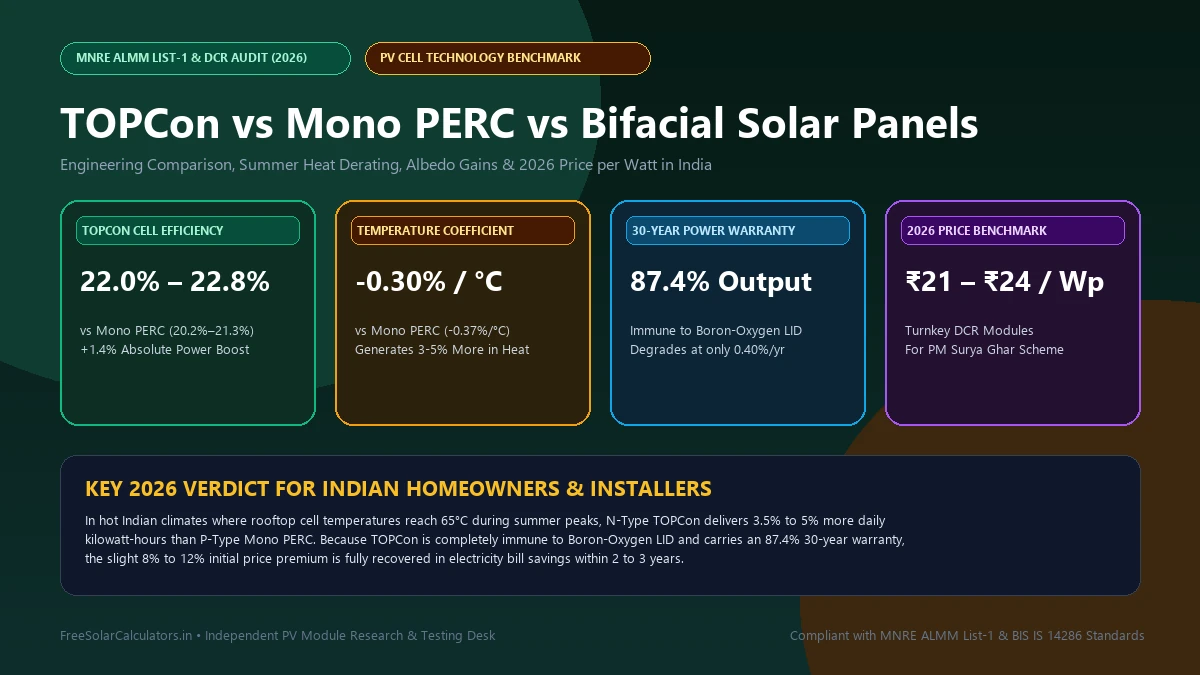
Selecting the right photovoltaic module technology is the single most critical engineering decision when installing rooftop solar in India. While older polycrystalline modules have virtually vanished from the residential landscape, Indian homeowners and commercial facilities today face a decisive choice: P-Type Mono PERC, N-Type TOPCon, or Bifacial Dual-Glass modules.
Understanding the engineering physics of these three technologies is vital for Indian conditions. Indian rooftops endure severe ambient summer heat (ambient shade air temperatures regularly exceed 42°C to 47°C across northern, western, and central states), extreme thermal cycling, heavy dust soiling, and monsoon humidity. Under direct noon sunlight, dark silicon solar panels frequently operate at 60°C to 72°C cell temperatures—far above laboratory test conditions.
This comprehensive technical guide breaks down the microscopic cell physics, summer thermal derating curves, 30-year degradation rates, terrace albedo gains, and prevailing 2026 turnkey price-per-watt benchmarks in India.
To calculate the exact number of panels and roof area needed for your home, you can run your electricity numbers through our interactive Solar Panel Calculator and check live balance-of-system pricing using our Solar Panel Cost Calculator.
1. Key Technical Differences at a Glance: 12-Parameter Matrix
Before diving into cell physics, review how the three dominant module categories compare across electrical, thermal, degradation, and pricing benchmarks under Indian conditions:
| Engineering Parameter | P-Type Mono PERC | N-Type TOPCon (Monofacial) | Bifacial Dual-Glass TOPCon |
|---|---|---|---|
| Silicon Substrate Base | P-Type (Boron-doped) | N-Type (Phosphorus-doped) | N-Type (Phosphorus-doped) |
| Microscopic Passivation | Al2O3 + SiNx dielectric stack | 1.5nm SiO₂ Tunnel Oxide + n+ Poly-Si | 1.5nm SiO₂ Tunnel Oxide + n+ Poly-Si |
| Module Commercial Efficiency | 20.2% – 21.3% | 22.0% – 22.8% | 22.2% – 23.2% (Front Only) |
| Temperature Coefficient (Pmax) | -0.35% to -0.38% / °C | -0.29% to -0.30% / °C | -0.29% to -0.30% / °C |
| First-Year Power Degradation | 1.8% – 2.0% (LID active) | ≤ 1.0% (LID-free) | ≤ 1.0% (LID-free) |
| Annual Degradation (Years 2 to 30) | 0.55% / year | 0.40% / year | 0.40% / year |
| Warranted Power Output at Year 25 | 84.8% of original rating | 89.4% of original rating | 89.4% of original rating |
| Warranted Power Output at Year 30 | Not warrantied (25-yr limit) | 87.4% of original rating | 87.4% – 89.0% of original rating |
| Bifaciality Factor | 0% (Opaque backsheet) | 0% (Opaque backsheet) | 75% to 85% rear energy capture |
| Busbar Configuration | 9BB to 10BB ribbons | 16BB SMBB Half-Cut Cells | 16BB SMBB Half-Cut Cells |
| Mechanical & Hail Durability | Single 3.2mm tempered glass | Single 3.2mm tempered glass | Dual 2.0mm + 2.0mm tempered glass |
| Prevailing 2026 Price per Watt | ₹18 – ₹21 / Wp | ₹21 – ₹24 / Wp | ₹23 – ₹27 / Wp |
To explore prevailing hardware costs and price-per-watt trends across Indian states, consult our comprehensive Solar Panel Price List 2026 or measure your panel footprint with the Panel Efficiency Calculator.
2. N-Type vs P-Type Silicon Physics: Why Doping Changes Everything
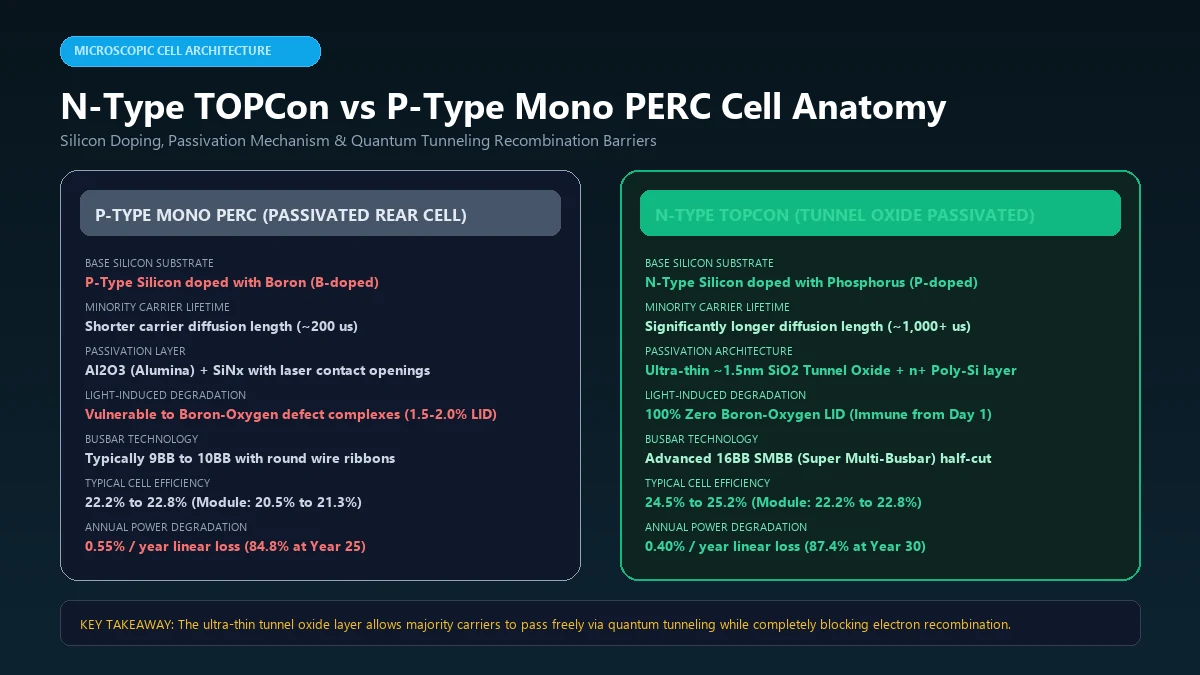
To understand why N-Type TOPCon has surpassed P-Type Mono PERC as the international technology benchmark, one must look at semiconductor wafer physics.
The Problem with P-Type Mono PERC (Boron Doping)
For over a decade, P-Type wafers were the standard choice because they were cheaper to manufacture using traditional Czochralski crystal growth methods.
- In a P-Type cell, pure silicon is doped with Boron atoms (trivalent impurity) to create positive charge carriers (electron holes).
- However, during the crystallization process, trace amounts of dissolved oxygen remain trapped inside the molten silicon ingot.
- When the finished solar panel is installed on your roof and exposed to solar radiation, the boron and oxygen atoms fuse to form Boron-Oxygen (B-O) defect complexes.
- These B-O complexes act as electronic recombination traps: electrons freed by sunlight fall into these traps instead of traveling into the electrical circuit, permanently lowering the cell's initial output by 1.5% to 2.0% within the first 100 hours of sunlight exposure. This phenomenon is known as Light-Induced Degradation (LID).
The N-Type TOPCon Advantage (Phosphorus Doping & Tunnel Oxide)
N-Type wafers resolve this problem entirely by doping the silicon with Phosphorus atoms (pentavalent impurity) instead of Boron.
- Zero Boron-Oxygen LID: Because there is zero boron in the silicon crystal lattice, TOPCon cells are 100% immune to Boron-Oxygen LID. The panel delivers its rated power from Day 1 without early degradation losses.
- Longer Minority Carrier Lifetime: Free charge carriers in phosphorus-doped silicon have a minority carrier diffusion length exceeding 1,000 microseconds, compared to only 150 to 250 microseconds in P-Type silicon. This allows electrons to travel further through the cell thickness without recombining.
- Tunnel Oxide Passivated Contact (TOPCon Layer): The distinguishing feature of TOPCon is its microscopic rear contact architecture. A chemically grown, ultra-thin 1.5-nanometer Silicon Oxide (SiO₂) tunnel layer is applied between the crystalline silicon and a heavily doped polycrystalline silicon layer.
- Under quantum mechanical principles, this atomic-scale oxide barrier allows majority carriers (electrons) to tunnel freely into the electrical contact while establishing a high chemical passivation barrier that prevents surface recombination.
- The result is an extraordinary open-circuit voltage (Voc) exceeding 715 to 735 mV (compared to 680 to 695 mV in Mono PERC), directly driving cell conversion efficiencies up to 24.5% to 25.2%.
3. Summer Heat Performance: Why TOPCon Wins in Indian Climates
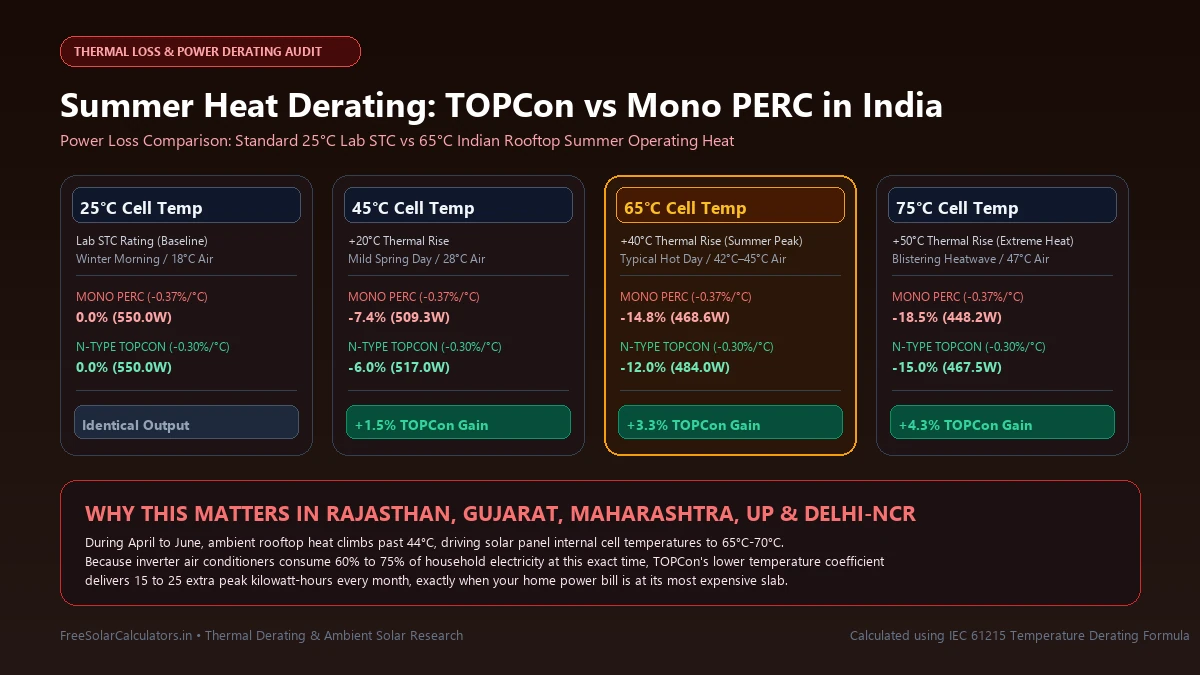
In India, solar panels do not operate in laboratory environments. While module performance datasheets are rated at Standard Test Conditions (STC: 25°C cell temperature, 1000 W/m² irradiance), real-world Indian conditions tell a very different story.
The Thermal Physics of Solar Modules
When a dark silicon module sits under direct noon sunlight on an RCC roof in Rajasthan, Gujarat, Maharashtra, Uttar Pradesh, Karnataka, Madhya Pradesh, or Delhi, ambient shade temperatures often hit 43°C to 47°C.
Because dark photovoltaic cells absorb infrared radiation, the Normal Operating Cell Temperature (NOCT) of the silicon wafer climbs 20°C to 25°C above the ambient air temperature, pushing operating cell temperatures to 65°C to 72°C.
As semiconductor temperatures rise, semiconductor bandgaps narrow and electron thermal agitation increases, causing module voltage to drop rapidly. This power loss is governed by the module's Temperature Coefficient of Maximum Power (Pmax):
Solar Module Thermal Derating Formula:
Power Loss (ΔP) = (Cell Operating Temperature − 25°C STC Baseline) × Temperature Coefficient (γPmax)
Real-World Summer Math: Mono PERC vs TOPCon at 65°C
Let us compare two 550 Watt panels operating on a hot summer afternoon in Ahmedabad or Jaipur at 65°C cell temperature (+40°C above standard 25°C laboratory test conditions):
1. 550W Mono PERC Panel
- Temperature Coefficient: -0.37% / °C
- Thermal Temperature Rise: 65°C − 25°C = +40°C thermal rise
- Thermal Power Derating: 40 × -0.37% = -14.80% power loss
- Realized Operating Output: 550W × (1 − 0.1480) = 468.6 Watts
2. 550W N-Type TOPCon Panel
- Temperature Coefficient: -0.30% / °C
- Thermal Temperature Rise: 65°C − 25°C = +40°C thermal rise
- Thermal Power Derating: 40 × -0.30% = -12.00% power loss
- Realized Operating Output: 550W × (1 − 0.1200) = 484.0 Watts
Midday Performance Advantage:
484.0 Watts − 468.6 Watts = +15.4 Watts per panel (+3.29% absolute generation gain)
On a standard residential 5 kW rooftop array comprising 9 panels, this thermal advantage produces an extra 138 Watts of continuous generation during peak midday heat.
Because this happens between 11:00 AM and 3:30 PM—the exact hours when your household inverter air conditioners run at maximum compressor load (as detailed in our Solar Panels for 1.5 Ton AC Guide)—the TOPCon system eliminates higher-tier grid units directly from your most expensive tariff bracket.
4. Degradation Curves: Boron-Oxygen LID Immunity and 30-Year Lifespan
A solar panel is a long-term capital investment designed to deliver electricity for a quarter of a century or more. The cumulative energy delivered over decades depends heavily on how slowly the silicon degrades.
Photovoltaic degradation occurs through three distinct mechanisms:
- Light-Induced Degradation (LID): Caused by Boron-Oxygen defects in P-type wafers during initial sunlight exposure. Mono PERC loses 1.5% to 2.0% upfront, whereas TOPCon experiences zero Boron-Oxygen LID.
- Light and Elevated Temperature-Induced Degradation (LeTID): In high-temperature, high-irradiance climates like India, hydrogen migration inside the passivation layer causes additional power loss. N-Type TOPCon demonstrates superior LeTID stability due to its chemically robust silicon dioxide tunnel oxide barrier.
- Potential-Induced Degradation (PID): Occurs when high system voltages (600V to 1000V DC string circuits) drive leakage sodium ions from the front glass into the solar cell. Dual-glass TOPCon panels, with non-conductive glass on both surfaces, provide virtually impenetrable PID resistance compared to standard polymer backsheets.
30-Year Power Output Trajectory
The table below illustrates the guaranteed minimum power output of a 550W module over its operational life:
| Milestone Year | P-Type Mono PERC (550W) | N-Type TOPCon Monofacial (550W) | Bifacial Dual-Glass TOPCon (550W) |
|---|---|---|---|
| Year 0 (STC Nameplate) | 550.0 W (100.0%) | 550.0 W (100.0%) | 550.0 W (100.0%) |
| Year 1 (Post-LID) | 539.0 W (98.0%) | 544.5 W (99.0%) | 544.5 W (99.0%) |
| Year 5 | 526.9 W (95.8%) | 535.8 W (97.4%) | 535.8 W (97.4%) |
| Year 10 | 511.8 W (93.0%) | 524.8 W (95.4%) | 524.8 W (95.4%) |
| Year 15 | 496.6 W (90.3%) | 513.8 W (93.4%) | 513.8 W (93.4%) |
| Year 20 | 481.5 W (87.5%) | 502.8 W (91.4%) | 502.8 W (91.4%) |
| Year 25 | 466.4 W (84.8%) | 491.8 W (89.4%) | 491.8 W (89.4%) |
| Year 30 | Out of Warranty | 480.7 W (87.4%) | 480.7 W – 489.5 W (89.0%) |
By Year 25, an N-type TOPCon module retains 491.8 Watts, delivering 25.4 Watts (+5.4%) more power per panel than an identically aged Mono PERC module.
Furthermore, Tier-1 TOPCon manufacturers back their modules with a 30-year linear performance warranty, giving you five extra years of contractually guaranteed power generation that Mono PERC modules do not offer.
To see how these degradation rates compound into lifetime rupee savings, review our detailed financial modeling in the Solar Panel ROI & Payback Guide or run your numbers through the Solar ROI & Payback Calculator.
5. Bifacial Solar Panels on Indian Terraces: Albedo Gains and Mounting Structure Heights
Bifacial solar panels replace the traditional white or black plastic backsheet with a second sheet of transparent tempered glass, allowing photovoltaic cells to absorb sunlight from both the front and rear surfaces.
How Rear-Side Generation Works
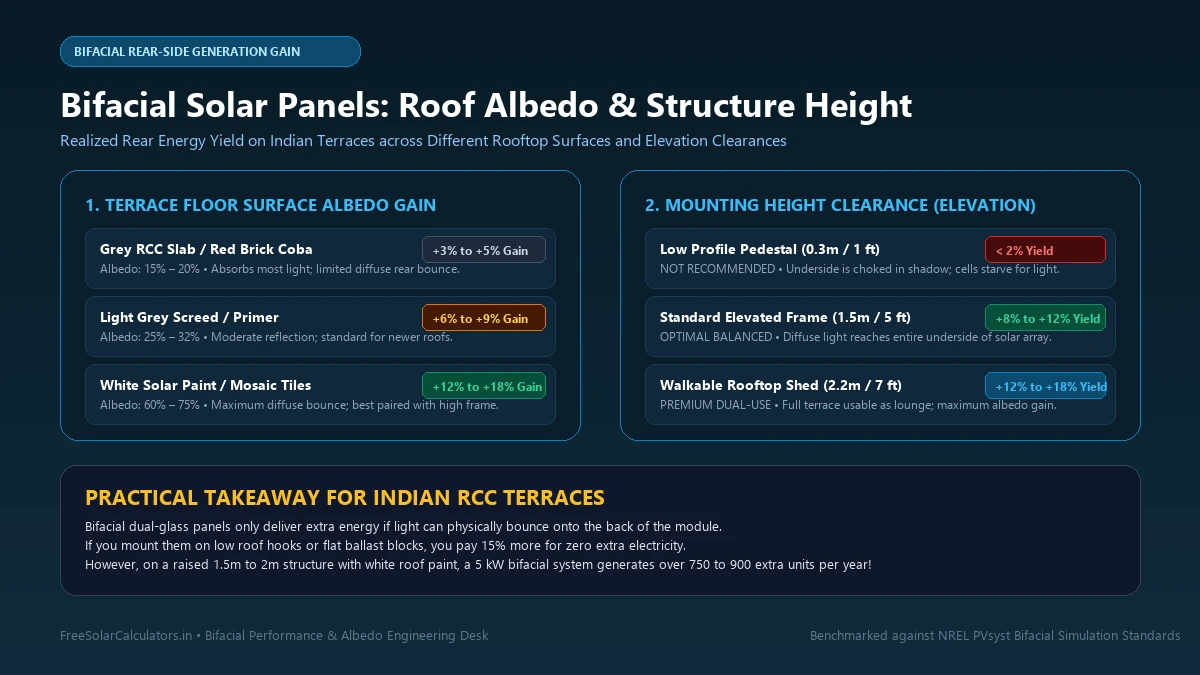
The front of the module captures direct beam sunlight and diffuse sky radiation. The rear of the module captures diffuse ground-reflected sunlight (albedo) bouncing off the surface of your terrace floor.
The extra energy produced by the backside depends on two physical factors:
- The Reflectivity (Albedo) of Your Roof Surface: How much light bounces off the floor.
- The Clearance Height of the Mounting Structure: How freely reflected light can reach the underside of the panels without being obstructed by shadow or module frames.
Terrace Surface Albedo Benchmarks
The table below outlines real-world rear-side generation gains across typical Indian terrace surfaces:
| Terrace Floor Surface | Surface Reflectivity (Albedo) | Realized Rear Generation Gain |
|---|---|---|
| Dark Red Brick Bat Coba / Weathered Dark Concrete | Low (15% – 20%) | +3% to +5% extra energy |
| Light Grey Concrete Screed / Weatherproof Primer | Moderate (25% – 32%) | +6% to +9% extra energy |
| White Mosaic Broken China Tiles (Prevalent in Gujarat/Maharashtra) | High (50% – 60%) | +10% to +14% extra energy |
| White Solar-Reflective Elastomeric Roof Paint (SRI > 100) | Very High (65% – 75%) | +14% to +18% extra energy |
Crucial Mounting Height Rules for Bifacial Panels
Many inexperienced installers mount bifacial panels on standard low-profile roof brackets (0.3 meters or 1 foot off the roof slab). This is a severe design error.
When panels are mounted only 30 cm off the terrace floor:
- The module array casts a dense, dark shadow directly underneath itself.
- Ground-reflected diffuse light cannot penetrate underneath the panels.
- Rear-side generation drops to less than 2%, completely wasting the extra money spent on bifacial modules.
The Golden Rules for Bifacial Installation on Indian Terraces:
- Minimum 1.5 Meter Elevation: Install modules on an elevated hot-dip galvanized iron (GI) structure with a rear clearance of at least 1.5 to 2.0 meters (5 to 6.5 feet) above the roof slab. This allows generous diffuse light to reach all rows from the sides.
- Double Use as a Rooftop Pergola / Terrace Shed: An elevated 2-meter bifacial structure creates a shaded, walkable terrace canopy underneath. Homeowners can use the rooftop for sit-outs, drying clothes, or evening walks without disturbing the solar installation.
- Paint the Floor White: Applying a coat of high-SRI white solar-reflective roof paint beneath the array costs roughly ₹15 to ₹22 per square foot, but boosts your annual solar unit generation by 12% to 16%, paying for the paint within the very first summer season.
6. Real-World Generation Case Studies: 3 kW & 5 kW Systems
To quantify the financial difference between these module choices, let us examine two real-world case studies for residential installations in India under average irradiation conditions (4.8 to 5.2 Peak Sun Hours per day).
Case Study A: Standard 3 kW Residential System (Monofacial Mono PERC vs Monofacial TOPCon)
A 3 kW setup is the most popular residential configuration under the PM Surya Ghar scheme, utilizing six 540W/550W modules.
- System Size: 3.3 kW DC array (6 x 550W modules) with a 3.0 kW grid-tied string inverter.
- Location: Jaipur, Rajasthan / Ahmedabad, Gujarat.
- Blended Electricity Tariff: ₹8.20 per unit (including duties and fuel surcharge).
| Performance Metric | 3.3 kW P-Type Mono PERC | 3.3 kW N-Type TOPCon | Net Advantage of TOPCon |
|---|---|---|---|
| Year 1 Generation | 4,680 kWh (Units) | 4,910 kWh (Units) | +230 kWh / year (+4.9%) |
| Year 1 Electricity Bill Savings | ₹38,376 | ₹40,262 | +₹1,886 / year |
| Year 10 Generation (Post-Degradation) | 4,352 kWh | 4,688 kWh | +336 kWh / year (+7.7%) |
| Year 25 Generation | 3,968 kWh | 4,389 kWh | +421 kWh / year (+10.6%) |
| Cumulative 25-Year Generation | 108,100 kWh | 116,450 kWh | +8,350 Units |
| Cumulative 25-Year Bill Savings | ₹12,98,000 | ₹13,98,200 | +₹1,00,200 Net Wealth |
| Initial Turnkey Cost Difference | Baseline (₹1,80,000) | +₹8,000 (₹1,88,000) | ₹8,000 extra upfront |
| Simple Payback on Price Premium | — | — | 4.2 Years to recover premium |
Conclusion: Spending an extra ₹8,000 upfront for N-Type TOPCon panels yields over ₹1,00,000 in additional lifetime electricity savings—a 12.5x return on the technology upgrade.
Case Study B: Premium 5 kW Residential System (Monofacial TOPCon vs Elevated Bifacial TOPCon)
For a larger home running multiple air conditioners and an EV charger, requiring ten 550W panels (5.5 kW DC):
- System Size: 5.5 kW DC array with a 5.0 kW grid-tied inverter.
- Terrace Conditions: 1.8-meter elevated GI structure with white reflective solar roof paint.
- Blended Electricity Tariff: ₹8.80 per unit (higher tariff bracket).
| Performance Metric | 5.5 kW Monofacial TOPCon | 5.5 kW Elevated Bifacial TOPCon | Net Advantage of Bifacial |
|---|---|---|---|
| Rear Albedo Gain | 0% | +12.5% Average Rear Gain | — |
| Year 1 Generation | 8,180 kWh (Units) | 9,200 kWh (Units) | +1,020 kWh / year |
| Year 1 Electricity Bill Savings | ₹71,984 | ₹80,960 | +₹8,976 / year |
| Cumulative 25-Year Generation | 194,000 kWh | 218,200 kWh | +24,200 Units |
| Cumulative 25-Year Bill Savings | ₹23,28,000 | ₹26,18,400 | +₹2,90,400 Extra Profit |
| Extra Cost (Panels + High Structure) | Baseline | +₹28,000 total | ₹28,000 extra upfront |
| Simple Payback on Bifacial Upgrade | — | — | 3.1 Years to recover |
Conclusion: When installed on a raised structure with white roof coating, bifacial TOPCon delivers over 24,000 extra units of electricity, putting nearly ₹3,00,000 of extra net profit into the homeowner's pocket while keeping the terrace fully walkable.
To calculate how many panels your rooftop requires, explore our How Many Solar Panels Calculator and size your electrical load with the Solar Load Calculator.
7. Government Compliance: PM Surya Ghar, ALMM List-1, and DCR Mandates
Before purchasing solar panels in India, you must verify compliance with two mandatory regulatory frameworks established by the Ministry of New and Renewable Energy (MNRE):
1. ALMM List-1 (Approved Models and Manufacturers)
Under the ALMM order, any grid-connected solar installation in India—including residential rooftop systems, commercial net-metered installations, and government tenders—must use solar modules listed on ALMM List-1.
If an installer attempts to sell you unapproved or grey-market modules that are not listed on the official ALMM register, your local DISCOM will reject your bi-directional net meter application, preventing your system from being commissioned.
2. Domestic Content Requirement (DCR)
To claim the ₹78,000 direct cash subsidy under the National Portal for PM Surya Ghar Muft Bijli Yojana, the solar modules must be certified as DCR Compliant:
- Both the silicon solar cells and the solar module assembly must be manufactured entirely inside India.
- If an installer uses modules assembled in India using imported Chinese solar cells (known as Non-DCR modules), the system may work technically, but you will forfeit 100% of your government subsidy (₹0 DBT credit).
Both DCR-compliant Mono PERC and DCR-compliant N-Type TOPCon panels are widely manufactured and available in India in 2026. Always require your solar EPC contractor to provide the official DCR Manufacturer Warranty Certificate with serial numbers matching the barcode on the module glass before signing off on payment.
You can verify your exact subsidy eligibility and net installation cost using our PM Surya Ghar Subsidy Calculator.
8. 2026 Price per Watt & Leading Indian Manufacturers
Following the rapid expansion of domestic cell and module manufacturing under the Production Linked Incentive (PLI) scheme, prices for Tier-1 ALMM-listed solar panels have stabilized in 2026:
| Solar Module Category | Ex-Factory Wholesale Price | Retail Turnkey Distributed Price | Best Suited Applications |
|---|---|---|---|
| P-Type Mono PERC (540W – 550W) | ₹14.50 – ₹16.50 / Wp | ₹18.00 – ₹21.00 / Wp | Budget residential roofs with ample terrace area |
| N-Type TOPCon Monofacial (550W – 580W) | ₹17.00 – ₹19.50 / Wp | ₹21.00 – ₹24.00 / Wp | Standard residential rooftops, maximum energy yield |
| Bifacial Dual-Glass TOPCon (550W – 590W) | ₹18.50 – ₹21.50 / Wp | ₹23.00 – ₹27.00 / Wp | Elevated rooftop sheds, pergolas, reflective terraces |
Leading Tier-1 ALMM & DCR Module Manufacturers in India
When obtaining quotes from solar installers, look for modules from reputable Tier-1 manufacturers with established domestic cell lines:
- Tata Power Solar: Long-standing reliability, extensive DCR Mono PERC and TOPCon module portfolios backed by nationwide service networks.
- Waaree Energies: India's largest module manufacturer by capacity, offering high-wattage 550W+ to 590W N-Type TOPCon modules with 16BB half-cut architecture.
- Adani Solar (Mundra Solar PV): Vertically integrated manufacturer producing domestic N-type TOPCon and Mono PERC cells and modules with high mechanical load ratings.
- Goldi Solar: Reputable Gujarat-based manufacturer known for premium quality control, micro-crack prevention, and DCR-certified modules.
- Premier Energies: Advanced cell and module manufacturing facility in Hyderabad with high-efficiency TOPCon production lines.
- Vikram Solar: Established Kolkata-based manufacturer with high-efficiency bifacial and monofacial modules certified for utility and rooftop sectors.
- Rayzon Solar: Fast-growing manufacturer offering competitive pricing on TOPCon and Mono PERC modules across western and northern India.
9. Decision Framework: Which Solar Panel Should You Choose for Your Roof?
Use this straightforward decision matrix to select the best solar panel technology for your specific roof type, local climate, and budget:
| Installation Scenario | Recommended Technology | Why This is the Right Choice | Expected Advantage |
|---|---|---|---|
| Standard Residential RCC Flat Roof or Sloped Tiled Roof | N-Type TOPCon (Monofacial) | Delivers 3.5% to 5% higher summer energy yield in hot climates; immune to Boron-Oxygen LID with 30-year warranty. | Gold standard for 85% of Indian homes; offsets expensive higher-tier power tariffs |
| Elevated Terrace Structure (1.5m to 2.2m Pergola or Walkable Shed) | Bifacial Dual-Glass TOPCon | Captures reflected diffuse light (albedo) from terrace floor while keeping terrace fully usable as a sit-out lounge. Best paired with white reflective solar paint or light tiles. | +12% to +18% bonus electricity generation; zero backsheet degradation |
| Budget-Constrained Residential Installation | P-Type Mono PERC | Lowest initial turnkey price per watt (₹18 to ₹21 / Wp). Viable only if capital is strictly limited and rooftop has excess unshaded area. | Lower initial upfront capital cost; recovers investment in ~4 years |
| Commercial / Industrial Metal Sheet Roof (PEB) | N-Type TOPCon (Monofacial 575W+) | High wattage and lightweight design with superior heat resistance on metal roofs where sheet temperatures exceed 70°C. | Maximum power density with minimal structural dead-weight on purlins |
| Commercial Flat Concrete Roof with Reflective Floor | Bifacial Dual-Glass TOPCon | Ballast mounting without roof penetrations, capturing maximum albedo across expansive open commercial terraces. | Substantially lower Levelized Cost of Energy (LCOE) across 30-year life |
Summary Recommendations by Use Case:
1. Choose N-Type TOPCon (Monofacial) if:
- You have a standard residential flat concrete roof or sloped tiled roof.
- You live in regions with hot summers (Rajasthan, Gujarat, Maharashtra, Uttar Pradesh, Delhi, Madhya Pradesh, Karnataka, Telangana).
- You want the maximum possible units generated per square foot of roof space to offset high tariff slabs.
- You want 30-year warranty security with low annual degradation.
2. Choose Bifacial Dual-Glass TOPCon if:
- You want an elevated rooftop structure (5 to 7 feet high) so your family can still walk, sit, and use the terrace underneath.
- You are willing to paint the terrace floor white or already have light-colored mosaic tiles.
- You want maximum long-term durability: dual-glass modules have zero backsheet polymer degradation, superior fire ratings, and withstand heavy monsoon humidity.
3. Choose P-Type Mono PERC if:
- You are on an extremely constrained initial capital budget and cannot stretch the extra 8% to 10% upfront cost for TOPCon.
- You have ample roof area and do not mind needing a slightly larger physical footprint to achieve your desired generation.
10. Practical Installer Checklist: What to Verify Before Signing an EPC Contract
Before making any down payment or signing a contract with a solar vendor, verify these critical technical checkpoints:
- Ask for the Specific Model Datasheet: Do not accept generic terms like "550W Tier-1 panels." Insist on the exact model number (e.g., Waaree WSMD-550, Adani Shine Series, Tata Power Solar TP-550). Check whether the datasheet states N-Type TOPCon or P-Type Mono PERC.
- Verify Temperature Coefficient: Check the electrical parameters table on the datasheet. Ensure the Temperature Coefficient of Pmax is -0.30%/°C or better for TOPCon (-0.35% to -0.38%/°C indicates older Mono PERC).
- Verify DCR Status for PM Surya Ghar: If you are claiming the ₹78,000 government subsidy, confirm in writing that the modules are DCR certified and demand the manufacturer's DCR certificate before installation begins.
- Inspect the Cell Busbars: Look closely at the solar cell surface. Modern TOPCon modules feature 16 micro-busbars (SMBB) with half-cut cell cuts, which reduce resistive losses and micro-cracking risks compared to older 9BB or 10BB wide ribbons.
- Check Dual-Glass Thickness for Bifacial: If buying bifacial modules, ensure the panel uses dual 2.0mm tempered glass (2.0mm front + 2.0mm rear) with an anodized aluminum frame for high mechanical strength against wind loads up to 150 km/h.
- Ensure Matching Inverter MPPT Voltage: Verify that your solar inverter's MPPT voltage range matches the string voltage of your chosen panels. A string of six 550W TOPCon modules typically produces around 250V to 270V DC under load, which must sit comfortably within your inverter's nominal MPPT tracking window.
For comprehensive state-by-state net metering regulations, solar irradiation figures, and local DISCOM guidelines, explore our localized state guides:
- Rajasthan Solar Policy & High-Irradiance Guide
- Gujarat Solar Slabs & Surya Gujarat Net Metering
- Maharashtra Solar Rules & MSEDCL Slabs
- Uttar Pradesh Solar Subsidy & UPPCL Portal
- Karnataka BESCOM Solar Net Metering Rules
Ready to model your personalized savings? Start by running your latest electricity bill through our interactive Solar Panel Calculator and discover your optimal system capacity today.
Calculate your own numbers
Model your rooftop capacity, subsidy eligibility, and payback periods using our specialized calculators.
Solar Panel Calculator India: Size, Panels & Roof Area
Instant capacity sizing (kW) and monthly generation output based on your monthly DISCOM bill.
Panel Efficiency Estimate
Simulate summer temperature derating losses and panel efficiency differences in Indian weather.
Solar Panel Price in India: Per Watt & Brand Comparison
Compare live 2026 price-per-watt benchmarks across TOPCon, Mono PERC, and DCR certified modules.
Frequently asked questions
What is the fundamental difference between N-Type TOPCon and P-Type Mono PERC solar panels?
The core difference lies in the silicon substrate base and rear passivation chemistry. P-Type Mono PERC uses boron-doped silicon wafers, which form boron-oxygen defects when exposed to sunlight, causing 1.5% to 2% initial light-induced degradation (LID). N-Type TOPCon uses phosphorus-doped silicon wafers with an ultra-thin (1.5nm) silicon oxide tunnel layer and heavily doped polycrystalline silicon. This architecture makes TOPCon 100% immune to boron-oxygen LID, lowers electrical recombination losses, raises module efficiency to 22.0%–22.8%, and provides a superior temperature coefficient of -0.30%/°C compared to -0.37%/°C in Mono PERC.
Are TOPCon solar panels worth the extra 8% to 12% price premium in India?
Yes, for virtually all residential and commercial rooftop installations in India. Because ambient rooftop temperatures frequently exceed 45°C during hot summer months (May to July) across states like Rajasthan, Gujarat, Maharashtra, Uttar Pradesh, and Delhi, TOPCon panels suffer significantly less thermal derating. A 3 kW or 5 kW TOPCon system generates roughly 4% to 6% more annual electricity than an identically sized Mono PERC setup. Over 25 to 30 years, this extra generation yields ₹45,000 to ₹95,000 in additional avoided electricity bills, recovering the initial price difference within 2 to 3 years.
Can I claim the ₹78,000 PM Surya Ghar Muft Bijli Yojana subsidy on TOPCon panels?
Yes, provided the TOPCon solar modules are certified under the Domestic Content Requirement (DCR) and listed on ALMM List-1 by the Ministry of New and Renewable Energy (MNRE). Leading Indian manufacturers including Tata Power Solar, Waaree Energies, Adani Solar, Goldi Solar, Premier Energies, and Vikram Solar produce certified DCR TOPCon modules eligible for the full central DBT subsidy of up to ₹78,000. Be cautious of imported non-DCR modules, which are strictly ineligible for government subsidies.
When should Indian homeowners choose Bifacial solar panels over Monofacial panels?
Bifacial solar panels generate power from both front and rear surfaces, producing 10% to 18% extra energy when mounted on raised galvanized iron structures (at least 1.5 to 2 meters above the roof slab) over high-albedo surfaces such as white reflective roof paint, light grey screed, or white mosaic tiles. If you plan to build an elevated rooftop pergola or shed that leaves your terrace walkable, bifacial panels are an excellent choice. However, if you are mounting modules flat on low pedestals (less than 1 foot clearance) over dark brick coba or grey concrete, rear light is blocked and bifacial panels will not yield extra generation.
How does extreme Indian summer heat affect solar panel generation?
Solar panels are tested at Standard Test Conditions (STC) of 25°C cell temperature. In Indian summers, direct solar radiation causes the internal temperature of dark silicon panels to reach 65°C to 72°C (40°C to 47°C above test conditions). For every degree Celsius above 25°C, panel power output drops by the temperature coefficient (Pmax). P-Type Mono PERC panels lose roughly 14.8% power at 65°C, whereas N-Type TOPCon panels lose only 12.0%. This thermal advantage means TOPCon panels generate substantially more units during blistering afternoons when home air conditioners run at peak compressor loads.
What is the expected lifespan and degradation warranty of modern TOPCon panels?
Tier-1 N-Type TOPCon solar panels typically come with a 12- to 15-year comprehensive product workmanship warranty and a 30-year linear performance warranty. First-year degradation is warrantied at 1.0% or less (compared to 2.0% in Mono PERC), followed by an annual degradation rate of only 0.40% per year from Year 2 through Year 30. At the end of 30 years, a quality TOPCon module is warrantied to retain at least 87.4% of its original rated generation capacity, compared to roughly 84.8% at 25 years for Mono PERC.
This technical guide is authored and audited against current Ministry of New & Renewable Energy (MNRE) guidelines, the National Portal for Rooftop Solar (pmsuryaghar.gov.in), Bureau of Indian Standards (BIS), and State Electricity Regulatory Commission (SERC) tariff schedules.
Disclaimer: Solar generation, net metering credits, and financial savings depend on local irradiation, terrace azimuth, and specific DISCOM net-metering regulations.
Related posts
PM Surya Ghar Solar Loan Rejections: Causes, District Magistrate Directives, and Step-by-Step Approval Solutions
Exhaustive legal and procedural guide on resolving PM Surya Ghar rooftop solar loan rejections: analyzing bank branch NPA fears, administrative review interventions by District Magistrates, RBI collateral-free lending caps, and step-by-step escalation protocols for rapid approval.
PM DHARA Scheme: ₹1.86 Lakh Crore Overhaul for India's Renewable Energy Grid & 50 GWh Battery Storage
Comprehensive technical breakdown of India's ₹1.86 lakh crore PM DHARA scheme: 135 GW transmission evacuation, 50 GWh BESS, ₹54,082 crore central assistance, and rooftop solar impact.