
PM DHARA Scheme: ₹1.86 Lakh Crore Overhaul for India's Renewable Energy Grid & 50 GWh Battery Storage
FreeSolar Technical Engineering Desk · 01 Oct 2026 · 13 min read
Understand DISCOM banking provisions, surplus feed-in settlement, and meter replacement costs.
On September 30, 2026, the Union Cabinet chaired by Prime Minister Narendra Modi cleared India’s most comprehensive clean energy grid initiative to date: the PM-DHARA (Prime Minister-Developing Harmonized and Accelerated Renewable-energy Access) scheme. With an authorized capital outlay of ₹1,86,405 crore, this mega-programme represents a decisive transformation from merely installing solar panels and wind turbines to engineering the resilient national grid infrastructure required to support them.
Announced in New Delhi by Union Minister for Information and Broadcasting Ashwini Vaishnaw, PM-DHARA directly targets the single greatest technical bottleneck confronting India’s clean energy transition: transmission congestion and grid intermittency. By committing ₹1,36,378 crore to state-level transmission lines and ₹50,000 crore to utility-scale Battery Energy Storage Systems (BESS), the scheme paves a secure transmission corridor to evacuate 135 GW of renewable energy across Indian states by FY 2032-33.
1. Why India Needed PM DHARA: The 300 GWh Transmission Curtailment Crisis
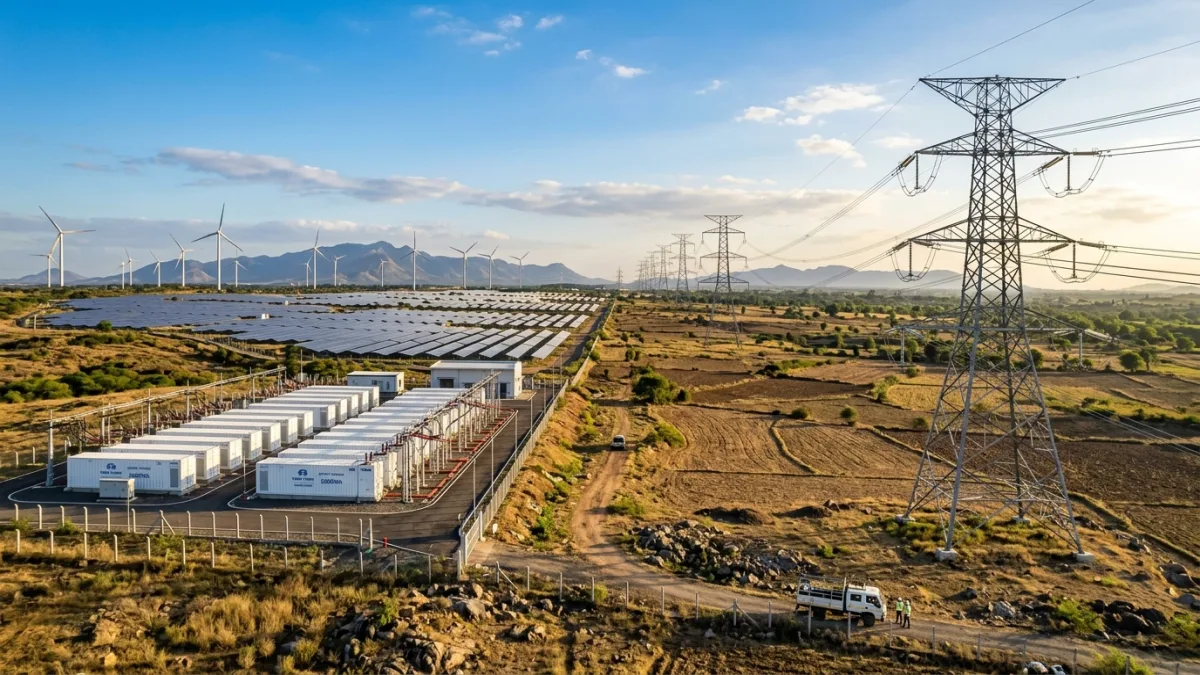
India has emerged as an undisputed global clean energy powerhouse, successfully installing over 270 GW of non-fossil fuel capacity on its determined march toward the national target of 500 GW by 2030 and 900 GW by 2035. However, generation capacity has grown at nearly twice the rate of intra-state transmission lines.
This widening gap triggered an acute operational crisis. A landmark report published in May 2026 by independent climate energy think tank Ember documented that India lost over 300 GWh (gigawatt-hours) of clean renewable energy in the first quarter of 2026 alone due to localized transmission bottlenecks and thermal line limits.
Renewable Capacity Growth (2020-2026):   +14.2% CAGR  ████████████████
Intra-State Grid Evacuation (2020-2026): +7.8% CAGR   █████████░░░░░░░
Result: 300 GWh Clean Energy Curtailed in Q1 2026 alone
Understanding Grid Curtailment
When mega-solar parks in Rajasthan, Gujarat, and Madhya Pradesh generate peak power between 11:30 AM and 2:00 PM, power lines reach their thermal carrying capacity. Because excess electrical current cannot safely flow without overheating overhead conductors and risking catastrophic voltage collapse, State Load Despatch Centres (SLDCs) are forced to order solar and wind developers to throttle back (curtail) generation.
Curtailment has direct economic consequences:
- Stranded Clean Energy: Billions of kilowatt-hours of clean zero-marginal-cost power are permanently discarded.
- Depressed Developer Returns: Independent Power Producers (IPPs) lose revenue on unsold power, challenging financial models and debt servicing.
- Fossil Fuel Peakers Kept Active: Because renewable energy cannot be routed across state lines during peak afternoon hours, state utilities must keep aging, expensive coal-fired and open-cycle gas turbine peakers on hot standby to meet evening demand.
PM-DHARA was formulated to decisively eliminate this curtailment bottleneck before India scales to 500 GW.
2. Scheme Architecture: Financial Outlay & Dual Delivery Mechanism
The total approved capital outlay of ₹1,86,405 crore makes PM-DHARA one of the largest power sector infrastructure initiatives in modern Indian history. The financial architecture balances federal budgetary grants with state utility capital and private investment.
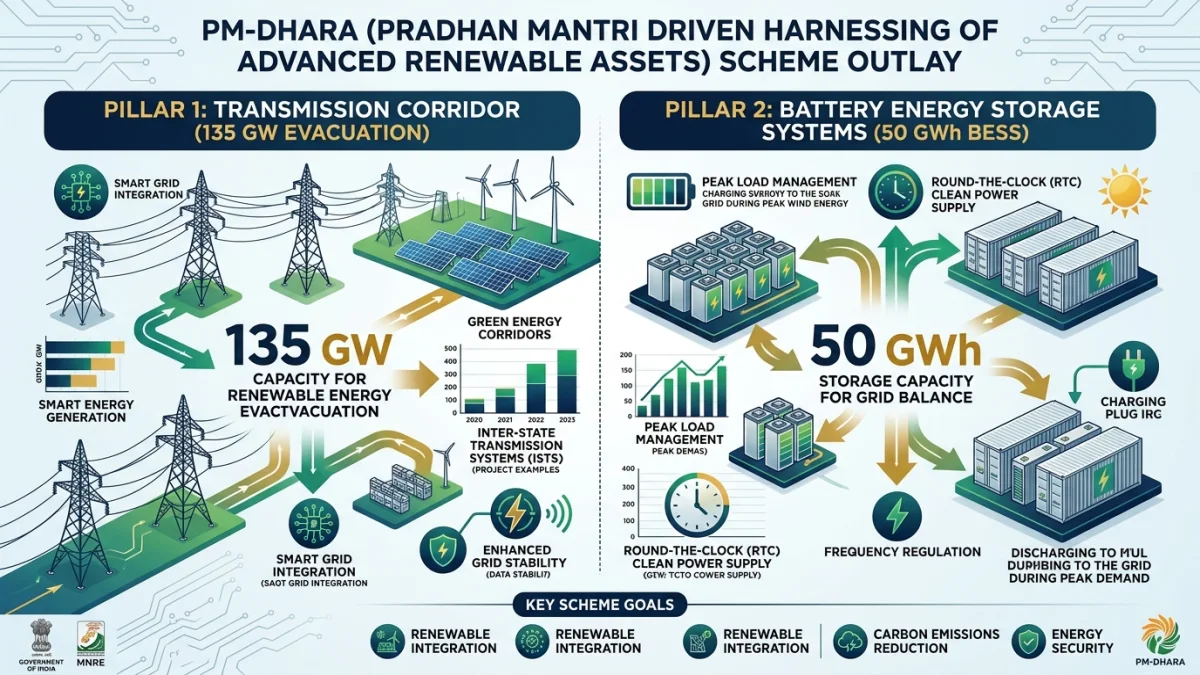
Capital Allocation Breakdown
| Programme Component | Capital Outlay (₹ Crore) | Targeted Physical Capacity | Primary Implementing Agencies |
|---|---|---|---|
| Intra-State Transmission (InSTS - GEC Phase-III) | ₹1,36,378 Cr | 135 GW Evacuation Capacity | State Transmission Utilities (STUs) & Private TBCB Bidders |
| Battery Energy Storage Systems (BESS) | ₹50,000 Cr | 50 GWh (Multi-Hour Utility Storage) | SECI, NTPC, PGCIL & State Utilities |
| Total Scheme Outlay | ₹1,86,405 Cr | 135 GW Grid + 50 GWh Storage | Target Completion: FY 2032-33 |
| Central Financial Assistance (CFA Support) | ₹54,082 Cr | Tariff Offset & Inter-State Subsidy | Ministry of Power / Government of India |
Dual Implementation Mechanism: TBCB vs Cost-Plus Upgrades
Recognizing that state budgets alone cannot fund thousands of kilometers of high-voltage transmission towers, the Ministry of Power and the Ministry of New and Renewable Energy (MNRE) have structured a smart dual-procurement model:
-
Greenfield Transmission Corridors (Tariff-Based Competitive Bidding - TBCB): New greenfield Extra High Voltage (EHV) corridors (400 kV, 765 kV AC lines and HVDC links) connecting newly demarcated renewable energy zones directly to state substations will be awarded to private developers on a Build, Own, Operate, and Maintain (BOOM) basis. Competitive market bidding ensures cost efficiency, tight project timelines, and minimal fiscal drag on state exchequers.
-
Brownfield Network Modernization (Cost-Plus Regulated Utility Model): Existing transmission substations, power transformers, line reconductoring (installing High-Temperature Low-Sag conductors), and telemetry upgrades will be directly carried out by State Transmission Utilities (STUs). To incentivize state utilities to execute rapid upgrades without financial risk, work is reimbursed on a guaranteed cost-plus basis, protecting utility balance sheets while assuring a fixed return on equity.
3. The 50 GWh Battery Energy Storage System (BESS): Taming the Solar Duck Curve
Of the total outlay, ₹50,000 crore is dedicated exclusively to deploying 50 GWh of Battery Energy Storage Systems (BESS) at strategic 400 kV and 220 kV state grid pooling substations.
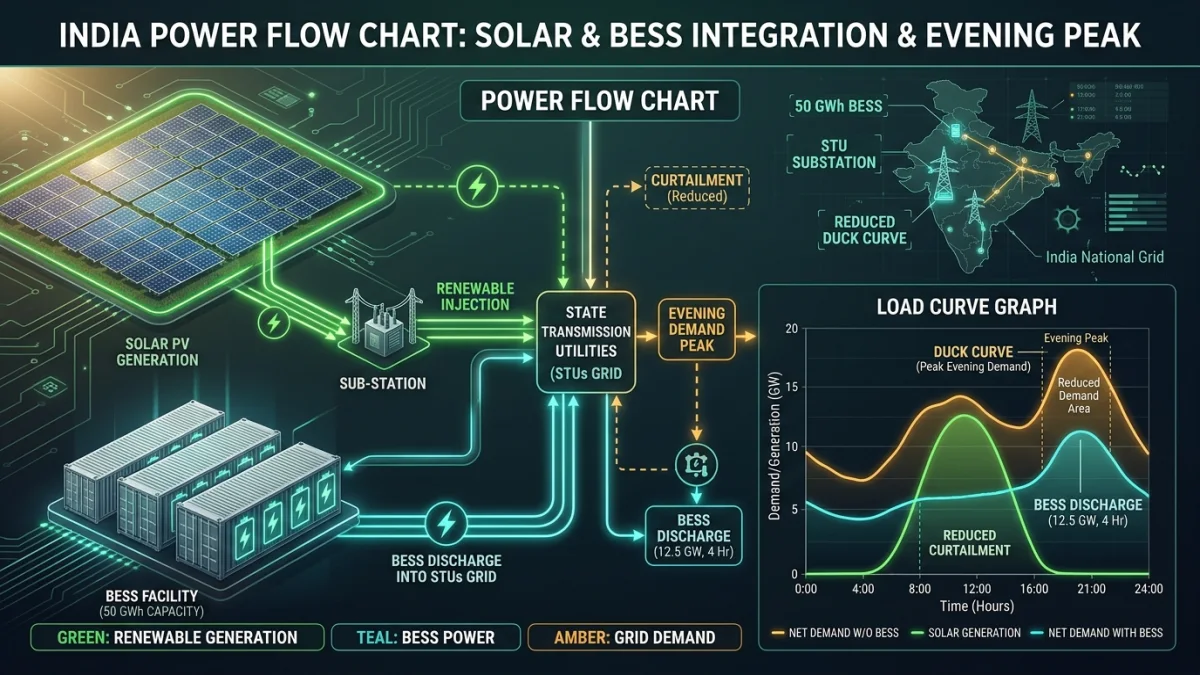
What Is the Solar "Duck Curve"?
In power systems engineering, the "duck curve" illustrates the deep imbalance between peak solar power production and consumer electricity demand:
- The "Belly" (10:00 AM – 3:30 PM): Massive generation from utility solar plants and residential rooftop panels floods the local grid, causing net grid demand to plummet.
- The "Neck" (6:00 PM – 10:30 PM): As the sun sets, solar generation drops to absolute zero at the exact moment millions of Indian homes switch on air conditioners, LED lights, water heaters, and television sets.
Without large-scale storage, this sudden, steep ramp-rate forces grid dispatchers to fire up expensive, polluting thermal peaker plants. If transmission networks cannot handle the rapid surge, grid frequency oscillates outside the statutory Indian Electricity Grid Code (IEGC) safety band of 49.90 Hz to 50.05 Hz, risking regional blackouts.
How 50 GWh BESS Balances the Grid
The 50 GWh battery fleet functions as a nationwide shock absorber:
- Afternoon Absorption: During the 11:00 AM – 3:00 PM solar surge, utility batteries absorb up to 12.5 GW of surplus electricity over a continuous 4-hour cycle, eliminating daytime solar curtailment.
- Evening Peak Discharge: From 6:30 PM to 10:30 PM, the batteries inject that stored zero-carbon electricity back into the state grid, completely displacing expensive peak-hour spot market electricity (which often hits the CERC price ceiling of ₹10 per unit on power exchanges like IEX).
- Ancillary Grid Services: Modern lithium-iron-phosphate (LFP) and sodium-ion BESS offer sub-second millisecond response times, providing synthetic inertia, primary frequency response, and dynamic reactive power (VAR) voltage support.
4. Consumer Tariff Shield: How the ₹54,082 Crore CFA Protects Electricity Bills
In conventional power utility economics, massive capital investments in transmission lines and substations inevitably lead to higher electricity bills for retail consumers. When a State Transmission Utility (STU) borrows thousands of crores to lay lines, state regulators allow them to recover those expenses through Intra-State Transmission System (InSTS) wheeling charges, which DISCOMs pass directly to domestic consumers as part of the tariff structure.
The Government of India has preemptively addressed this concern. Under PM-DHARA, the Centre provides ₹54,082 crore as non-repayable Central Financial Assistance (CFA):
- Direct Grant Funding: Approximately 33% of the intra-state transmission component is funded directly from the federal budget, removing capital expenditure from the state utility's Aggregate Revenue Requirement (ARR).
- Inter-State Transmission Charge (ISTS) Offsets: The central package subsidizes cross-border transmission wheeling charges, shielding consumers from price volatility when power is wheeled between surplus generation states (like Rajasthan) and deficit consumption states (like Delhi or Bihar).
- Retail Tariff Stabilization: By dampening peak evening spot prices through BESS discharge, the overall power purchase cost (PPC) for DISCOMs decreases, creating downward pressure on monthly household and industrial electricity bills.
5. Direct Impact on Rooftop Solar & PM Surya Ghar Consumers
While PM-DHARA focuses primarily on state transmission utilities, its operational benefits will immediately resolve the largest pain point faced by Indian residential rooftop solar owners.
Under the PM Surya Ghar: Muft Bijli Yojana, over 1.3 crore Indian households are transitioning to rooftop solar. However, thousands of applicants across Uttar Pradesh, Maharashtra, Rajasthan, and Gujarat have experienced frustrating delays in net-metering sanctions.
The Distribution Transformer (DT) Bottleneck
Central Electricity Authority (CEA) regulations state that solar power back-fed into a local distribution transformer (DT) must not exceed 70% to 80% of the transformer's rated kVA capacity.
When multiple homes in a residential colony install 3 kW or 5 kW solar systems, the cumulative daytime export overloads the local 11 kV / 415 V transformer. If the upstream 33 kV and 66 kV sub-transmission network is congested, DISCOM engineers have no choice but to:
- Deny net-metering approvals to new rooftop applicants.
- Force homeowners to downsize their solar plant (e.g., approving only 2 kW instead of the requested 5 kW).
- Impose zero-export limiters, preventing homeowners from earning solar net-metering credits.
Homeowners Install Rooftop Solar -> Solar Surplus Injected into 11kV Substation
-> PM-DHARA EHV Substation Upgrades Evacuate Local Surplus
-> Local Distribution Transformers Relieved -> Instant Net-Metering Approvals!
How PM-DHARA Clears the Way for Rooftop Solar
By modernizing 33 kV, 66 kV, and 132 kV intra-state substations, PM-DHARA allows surplus solar electricity generated on residential terraces to flow smoothly up the voltage ladder into state transmission highways.
This unlocks four critical advantages for rooftop owners:
- Accelerated Net-Metering Approvals: Local DISCOMs can approve residential rooftop applications without fearing localized transformer overload. Check your rooftop eligibility with our free PM Surya Ghar Subsidy Calculator.
- Stable Grid Voltage: String inverters will no longer trip with AC Overvoltage faults (often occurring when daytime grid voltage spikes above 253V due to high solar density on weak lines).
- Maximizing Feed-In Revenue: Homeowners can safely export 100% of their daytime surplus. Calculate your potential export earnings with our Solar Export Earnings Calculator.
- Better Return on Investment: With zero curtailment, your payback timeline reduces to 3.2 to 4.2 years. Model your financials using the Solar ROI Calculator.
6. PM-DHARA vs Green Energy Corridor Phase-I & II: Comparative Analysis
To appreciate the scale and technical evolution of PM-DHARA, it is essential to compare it with India’s earlier Green Energy Corridor (GEC) initiatives:
| Feature / Metric | GEC Phase-I (2015 – 2020) | GEC Phase-II (2022 – 2026) | PM-DHARA (2026 – 2033) |
|---|---|---|---|
| Total Capital Outlay | ~₹10,141 Crore | ~₹12,031 Crore | ₹1,86,405 Crore (15x Expansion) |
| Central Assistance (CFA) | ~₹4,056 Crore (40%) | ~₹3,970 Crore (33%) | ₹54,082 Crore |
| Target Evacuation Capacity | ~24 GW RE | ~20 GW RE | 135 GW RE |
| Grid Focus | Basic InSTS in 8 States | Inter-State & InSTS in 7 States | Universal Intra-State (InSTS) All States/UTs |
| Storage Integration | Zero Utility Storage | Minimal Pilot Projects | 50 GWh Dedicated BESS (₹50,000 Cr) |
| Procurement Model | STU Works Only | STU Works | Hybrid: Greenfield TBCB + Brownfield STU |
| Primary Beneficiary | Mega Solar Parks | Large Wind/Solar Zones | Utility Plants, C&I, and Rooftop Grids |
PM-DHARA is not simply an incremental extension; it represents a comprehensive structural reboot of India's transmission planning, prioritizing state-level distribution health alongside mega-corridor construction.
7. Institutional Roadmap to 500 GW by 2030
Implementing an infrastructure programme spanning 28 states and 8 union territories requires close coordination across key central and state entities:
- Ministry of Power & MNRE: Overseeing policy formulation, capital disbursement of the ₹54,082 crore CFA, and monitoring project milestones.
- Central Electricity Authority (CEA): Designing standardized technical specifications for 50 GWh BESS integration, dynamic reactive power compensation, and high-temperature conductors.
- Power Grid Corporation of India (PGCIL): Acting as technical advisor and project management consultant (PMC) for state utilities requiring engineering support.
- State Transmission Utilities (STUs): Executing brownfield substation overhauls, stringing second-circuit conductors, and installing smart supervisory control and data acquisition (SCADA) systems.
- Private Transmission Developers: Bidding on greenfield lines via transparent e-reverse auctions on the DEEP portal.
With completion slated for FY 2032-33, PM-DHARA provides the structural backbone that ensures India's planned 500 GW clean energy fleet in 2030 and 900 GW fleet in 2035 delivers reliable, uninterrupted power to every factory, farm, and home.
8. Key Takeaways for Homeowners and Clean Energy Stakeholders
The Cabinet's clearance of the ₹1.86 lakh crore PM-DHARA scheme is the strongest signal yet that India is building a 21st-century power grid capable of handling the clean energy boom.
For Indian homeowners, commercial establishments, and solar installers:
- Grid Reliability Will Improve: Frequent feeder trips, voltage surges, and transformer burnouts will drastically decline as intra-state networks receive ₹1.36 lakh crore in upgrades.
- Net Metering Is Here to Stay: Rather than curbing rooftop exports, state grids are expanding capacity to absorb every kilowatt-hour your rooftop generates.
- Lower System Payback Times: With reliable grid power banking, residential rooftop solar remains the single best financial investment for Indian families, generating a tax-free IRR exceeding 25% to 30%.
To calculate your rooftop capacity, subsidy eligibility, and estimated electricity bill savings under current 2026 regulations, explore our suite of engineering tools:
Calculate your own numbers
Model your rooftop capacity, subsidy eligibility, and payback periods using our specialized calculators.
Net Metering Calculator India: Import, Export & Bills
Understand DISCOM banking provisions, surplus feed-in settlement, and meter replacement costs.
Solar Export Earnings Calculator India
Calculate monthly and annual revenues from exporting excess solar energy back to the grid under current feed-in tariffs.
PM Surya Ghar Calculator: Subsidy, Cost & Savings
Check official ₹30,000 to ₹78,000 subsidy eligibility and net installation cost under 2026 guidelines.
Frequently asked questions
What is the PM DHARA scheme approved by the Union Cabinet?
PM DHARA (Prime Minister-Developing Harmonized and Accelerated Renewable-energy Access) is a landmark ₹1,86,405 crore national initiative cleared by the Union Cabinet on September 30, 2026. It modernizes India's intra-state transmission network to evacuate 135 GW of clean power and installs 50 GWh of utility-scale Battery Energy Storage Systems (BESS) by FY 2032-33.
How much financial assistance is the Central Government providing under PM DHARA?
Out of the total ₹1,86,405 crore outlay, the Central Government provides ₹54,082 crore in direct Central Financial Assistance (CFA). This budgetary support directly offsets intra-state wheeling charges and inter-state transmission fees, preventing higher grid costs from spilling into retail consumer electricity bills.
Why is 50 GWh of Battery Energy Storage Systems (BESS) necessary for India's grid?
Solar power peaks between 11:00 AM and 3:00 PM, while peak electricity demand occurs after sunset (6:30 PM to 10:30 PM). 50 GWh of BESS absorbs surplus midday generation, eliminates transmission curtailment, and discharges clean electricity during evening peak hours, stabilizing the grid frequency at 50 Hz without burning fossil fuels.
How does the PM DHARA scheme benefit residential rooftop solar and PM Surya Ghar consumers?
DISCOMs frequently delay or reject rooftop solar net-metering sanctions when local 11 kV / 33 kV distribution transformers exceed their statutory 70% capacity limit. By modernizing state transmission substations and lines, PM DHARA eliminates localized grid bottlenecks, enabling DISCOMs to approve more rooftop net-metering connections seamlessly.
What is the implementation timeline and procurement model for PM DHARA?
The scheme will run until FY 2032-33. New greenfield transmission corridors will be awarded via Tariff-Based Competitive Bidding (TBCB) under a Build, Own, Operate, and Maintain (BOOM) model, while brownfield upgrades of existing substations and towers will be executed on a cost-plus basis by State Transmission Utilities (STUs).
What caused the renewable energy curtailment crisis in 2026?
A report by independent energy think tank Ember revealed that India lost 300 GWh of clean renewable electricity in the first quarter of 2026 alone. This curtailment occurred because renewable generation capacity (surpassing 270 GW) expanded faster than the intra-state evacuation lines needed to deliver that power to consumption hubs.
This technical guide is authored and audited against current Ministry of New & Renewable Energy (MNRE) guidelines, the National Portal for Rooftop Solar (pmsuryaghar.gov.in), Bureau of Indian Standards (BIS), and State Electricity Regulatory Commission (SERC) tariff schedules.
Disclaimer: Solar generation, net metering credits, and financial savings depend on local irradiation, terrace azimuth, and specific DISCOM net-metering regulations.
Related posts
PM Surya Ghar Solar Loan Rejections: Causes, District Magistrate Directives, and Step-by-Step Approval Solutions
Exhaustive legal and procedural guide on resolving PM Surya Ghar rooftop solar loan rejections: analyzing bank branch NPA fears, administrative review interventions by District Magistrates, RBI collateral-free lending caps, and step-by-step escalation protocols for rapid approval.
TOPCon vs Mono PERC vs Bifacial Solar Panels: 2026 Comparison & Price Guide
Complete engineering comparison of N-Type TOPCon, P-Type Mono PERC, and Bifacial dual-glass solar panels for Indian rooftops: cell efficiency, summer heat tolerance, degradation rates, DCR rules, and 2026 prices.