
How Many Solar Panels for 1.5 Ton AC? (5-Star vs 3-Star Inverter AC)
FreeSolar Engineering Team · 19 Sep 2026 · 15 min read
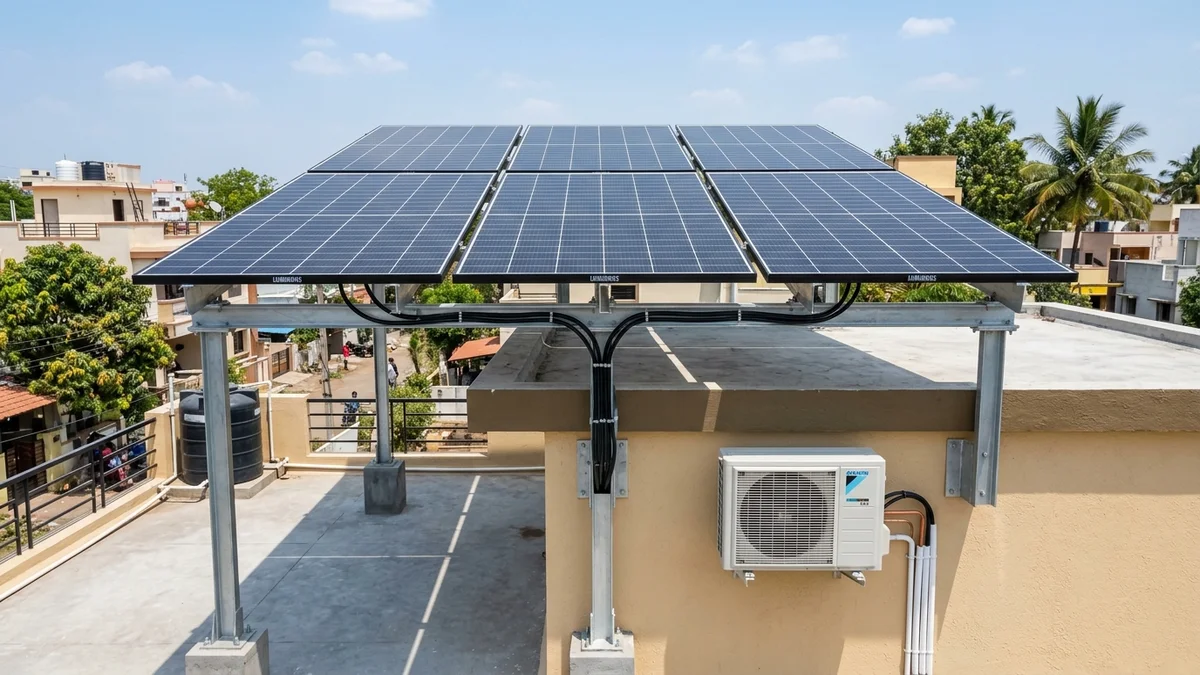
Determine the exact solar panel wattage, inverter kVA, and battery bank needed for 1.0T, 1.5T or 2.0T AC.
During intense Indian summer heat waves in states like Rajasthan, Gujarat, Maharashtra, and Uttar Pradesh, air conditioning accounts for 55% to 75% of a household's monthly electricity bill. When utility tariffs jump into higher consumption slabs (often ₹7 to ₹10 per unit), running a single 1.5 Ton AC for 8 to 12 hours a day can easily add ₹3,000 to ₹5,500 to your monthly bill.
Because peak cooling demand coincides directly with the hours of maximum solar irradiation (10:00 AM to 4:00 PM), rooftop solar is the most effective engineering solution to eliminate summer air conditioning expenses.
However, sizing a solar setup for an air conditioner requires precise understanding of compressor technology, starting surge currents, thermal derating, and inverter capacity. This guide provides the complete engineering breakdown, real power ratings, equipment specifications, and 2026 cost figures under the PM Surya Ghar scheme.
1. Power Consumption: 1.5 Ton AC Electrical Ratings Explained
A common point of confusion among homeowners is equating "1.5 Ton" with 1.5 kW of electrical power draw.
In air conditioning terminology, a "Ton" is a unit of cooling capacity, not electrical consumption. One Ton of refrigeration equals 12,000 British Thermal Units (BTU) per hour, or approximately 3,516 Watts of heat removal capacity from a room.
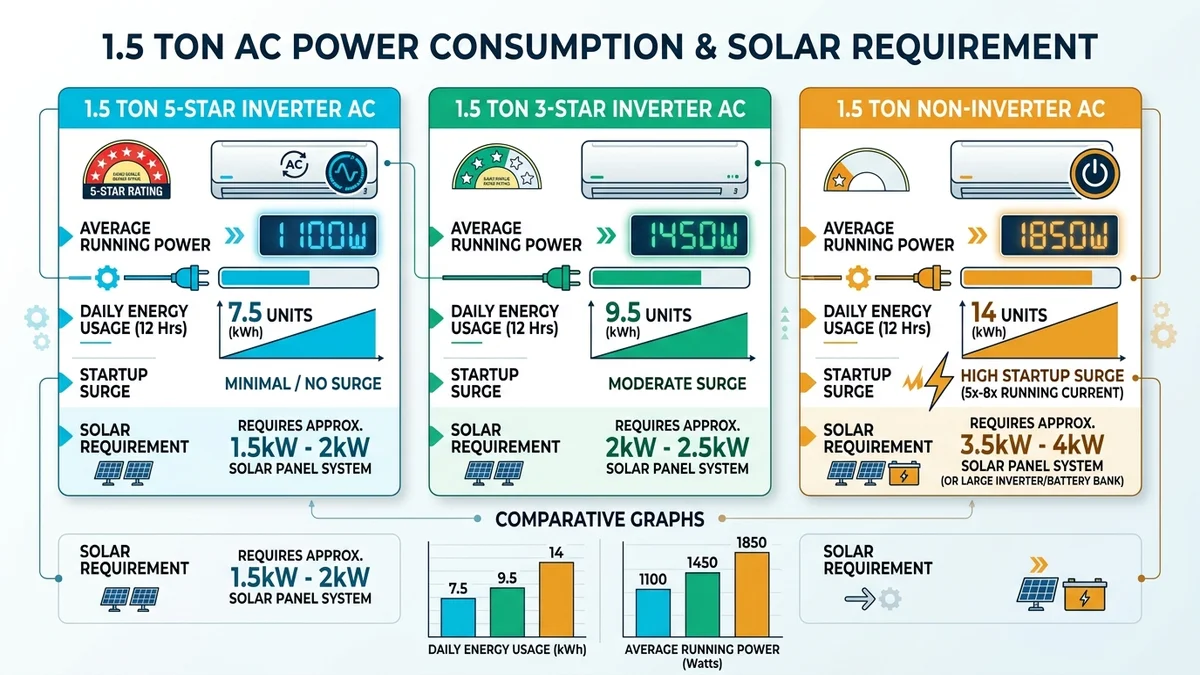
The actual electrical power drawn from your wall socket depends on the energy efficiency of the machine, measured by its Indian Seasonal Energy Efficiency Ratio (ISEER) rating regulated by the Bureau of Energy Efficiency (BEE India).
| AC Type & BEE Star Rating | ISEER Range | Rated Peak Power (Watts) | Cruising Power (After 25 Mins) | Typical Units per 8 Hours |
|---|---|---|---|---|
| 1.5 Ton 5-Star Inverter AC | 5.00 – 5.80+ | 1,150W – 1,350W | 450W – 650W | 6.5 – 7.8 kWh (Units) |
| 1.5 Ton 3-Star Inverter AC | 3.80 – 4.40 | 1,400W – 1,600W | 700W – 900W | 8.5 – 10.2 kWh (Units) |
| 1.5 Ton Non-Inverter (Fixed Speed Split/Window) | 3.10 – 3.50 | 1,750W – 1,950W | 1,750W (Cycles ON/OFF) | 12.0 – 14.8 kWh (Units) |
Modern inverter air conditioners utilize variable-speed Brushless DC (BLDC) compressors. When first switched on in a warm 35°C room, the compressor spins at maximum frequency, drawing 1,200W to 1,400W to bring the room down to the set thermostat temperature (e.g., 24°C). Once stabilized, the compressor slows down, maintaining room temperature while drawing only 450W to 650W.
In contrast, older non-inverter air conditioners operate at full 100% capacity continuously. When the room reaches the target temperature, the compressor cuts off completely; when the room warms up, it kicks back on with a severe electrical surge.
To calculate the combined wattage of your other household appliances running alongside your AC, use our interactive Solar Load Calculator.
2. How Many Solar Panels for Daytime AC Operation?
If you intend to run your air conditioner during the day (9:00 AM to 5:00 PM), rooftop solar operates at peak synergy with your cooling requirements.
Engineering Sizing Calculation
In sunny Indian states, a 1 kW solar array generates an average of 4.0 to 4.5 units (kWh) of electricity per day.
However, designing an array to run an inductive motor load like an AC requires accounting for three critical real-world derating factors:
- High Summer Temperature Derating: When ambient summer temperatures reach 42°C to 46°C in cities like Delhi, Ahmedabad, or Jaipur, solar panel surface temperatures climb to 65°C to 70°C. Standard monocrystalline panels experience a temperature coefficient loss of roughly -0.35% per °C above 25°C, reducing peak noon efficiency by 12% to 15%.
- Inverter and BOS Transmission Losses: DC-to-AC conversion and wiring resistance result in an additional 4% to 6% loss.
- Household Base Loads: An operating home has additional constant loads—refrigerator (~180W), three ceiling fans (~150W), LED lights (~50W), and Wi-Fi router (~15W)—adding approximately 400W of concurrent load.
Therefore, to reliably sustain a 1,200W inverter AC plus 400W base loads (1,600W total running load), solar engineers apply a 1.35x safety margin:
Minimum Continuous Solar Power Calculation:
Minimum Power Needed = 1,600 Watts concurrent load × 1.35 safety margin = 2,160 Watts (2.16 kW)
To provide consistent performance during partially cloudy intervals and morning/late-afternoon sun angles, a 3.0 kW to 3.3 kW solar array is the recommended baseline for a 1.5 Ton air conditioner.
Panel Count by Wattage Rating
The number of solar modules needed depends on the module wattage you choose:
| Solar Panel Technology & Wattage | Minimum Setup (AC Only) | Recommended Setup (AC + Home Loads) | Required Shadow-Free Roof Space |
|---|---|---|---|
| 550W Mono PERC / N-Type TOPCon Panels | 4 Panels (2.20 kW) | 6 Panels (3.30 kW) | 190 – 220 sq ft |
| 540W Half-Cut Bifacial Panels | 4 Panels (2.16 kW) | 6 Panels (3.24 kW) | 190 – 220 sq ft |
| 400W Mono PERC Panels | 6 Panels (2.40 kW) | 8 Panels (3.20 kW) | 220 – 250 sq ft |
| 330W Polycrystalline Panels (Older standard) | 7 Panels (2.31 kW) | 10 Panels (3.30 kW) | 270 – 310 sq ft |
For modern residential installations, 550W N-Type TOPCon or Mono PERC panels are the industry standard. Installing 6 high-efficiency 550W panels requires only about 200 square feet of terrace area, leaving ample space on your roof.
Find out how many modules fit your terrace space with our How Many Solar Panels Calculator or use our dedicated Solar Panels for AC Calculator for multi-room load simulations.
3. Inverter Sizing and Surge Current Protection
The solar inverter converts DC current from your solar panels into stable 230V, 50Hz AC electricity matching your domestic grid. Sizing the inverter correctly is vital to prevent overload trip-outs.
Inverter AC vs Non-Inverter Starting Surge
The starting behavior of your air conditioner dictates your inverter specifications:
- Inverter ACs (Variable BLDC Compressor): Modern inverter compressors ramp up smoothly over 15 to 30 seconds using intelligent electronic motor controllers. Their starting current surge is minimal, rarely exceeding 1.1x to 1.3x their operating current. A standard 3 kW or 3.3 kW on-grid solar inverter handles a 1.5 Ton inverter AC with complete ease.
- Non-Inverter ACs (Single-Speed Reciprocating/Rotary Compressor): When a fixed-speed compressor motor starts from a dead standstill, it draws what electrical engineers call Locked Rotor Amps (LRA). For 300 to 500 milliseconds, the compressor demands 3.5x to 5.0x its rated running current. A 1,800W non-inverter AC can momentarily draw over 6,000 Watts. If connected to an undersized 3 kVA off-grid inverter, this instantaneous inductive inrush will trigger the inverter's overload protection and trip the system. Running a non-inverter AC on a standalone system requires at least a 5 kVA to 6 kVA inverter rated for 200% momentary surge capacity.
Determine the right inverter capacity for your household load using our Inverter Size Calculator.
4. Running a 1.5 Ton AC at Night: Battery Bank vs Net Metering
Solar panels produce power only during daylight hours. If your primary goal is running your air conditioner during the night for 8 hours of sleep, you have two architectural options: installing a battery energy storage system (off-grid/hybrid) or utilizing on-grid net metering.
Sizing a Battery Bank for 8 Hours of Night Operation
At night, ambient temperatures are lower, allowing a 1.5 Ton 5-star inverter AC set to 24°C or 25°C to cruise at approximately 800W to 850W average power draw.
Overnight AC Electricity Requirement:
Energy Required = 8 Hours × 0.85 kW = 6.8 kWh (Units)
Usable Battery Storage Required (at 90% inverter efficiency) = 6.8 kWh ÷ 0.90 = 7.55 kWh
Battery Technology Comparison for Air Conditioning
| Battery Chemistry | Usable Depth of Discharge (DoD) | Total Capacity Needed | Required Battery Setup | Estimated Battery Outlay | Expected Lifespan |
|---|---|---|---|---|---|
| Tubular Lead-Acid (12V 150Ah) | 50% max (degrades rapidly if drained deeper) | 15.1 kWh | 8 Batteries (48V bank, 2 parallel strings of 4) | ₹1,10,000 – ₹1,30,000 | 3 to 4 Years |
| Lithium Iron Phosphate (LiFePO4 48V) | 85% to 90% | 8.5 kWh | 1 or 2 Rack/Wall Modules (48V 175Ah or 2 × 100Ah) | ₹1,65,000 – ₹2,10,000 | 10 to 12 Years |
Building a standalone battery bank to run an air conditioner overnight is capital intensive. In addition to the ₹1.1 to ₹2.1 Lakh battery cost, lead-acid batteries emit fumes, require periodic distilled water top-ups, and must be replaced every 3 to 4 years.
Why On-Grid Net Metering is 3x Cheaper
For homeowners in urban and suburban areas of Maharashtra, Gujarat, Delhi, Karnataka, Tamil Nadu, and Uttar Pradesh with stable electricity grids, an On-Grid Solar System with Net Metering is far more economical than battery storage:
flowchart LR
    A["Daytime Solar Generation (3.3 kW)"] --> B["Powers 1.5 Ton AC Directly"]
    A --> C["Surplus Power Exported to DISCOM Grid"]
    C --> D["Net Meter Records Export Credits"]
    D --> E["Nighttime: Grid Powers AC Seamlessly"]
    E --> F["Month-End: Export Units Offset Night Consumption = Near-Zero Bill"]
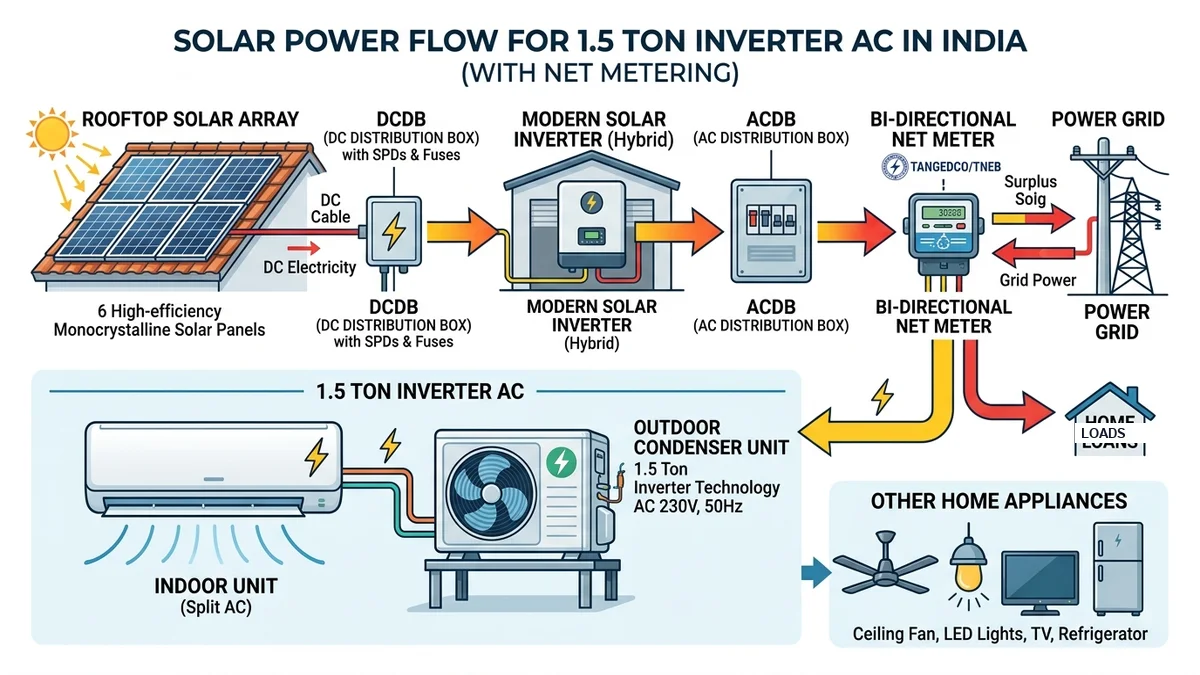
- Daytime Export: During the day, your 3.3 kW solar panels run your AC and send 4 to 6 surplus units into the government power grid through your bi-directional net meter.
- Nighttime Power: At night, your air conditioner draws grid power as usual with 100% reliability and zero battery degradation worries.
- Month-End Settlement: Your electricity distribution company (DISCOM) subtracts the exported daytime units from your nighttime consumption unit-for-unit.
- Zero Maintenance: You enjoy a zero or near-zero electricity bill without spending a single rupee on batteries.
Evaluate battery backup specifications with our Solar Battery Capacity Calculator and explore how grid credits offset night bills with our Net Metering Savings Calculator and On-Grid Solar System Calculator.
5. 2026 Cost Breakdown & PM Surya Ghar Subsidy
Under the central government's PM Surya Ghar: Muft Bijli Yojana managed by the Ministry of New and Renewable Energy (MNRE) and accessible via the National Rooftop Solar Portal, residential consumers receive direct financial subsidies for rooftop solar installations.
Financial Analysis for a 3 kW System (Ideal for 1.5 Ton AC)
A 3 kW on-grid solar system comfortably covers a 1.5 Ton inverter AC plus standard household base loads. Here is the typical capital expenditure and financial return breakdown for 2026:
| Item / Parameter | Benchmark Cost / Value |
|---|---|
| Gross Turnkey Installation Cost (3 kW) | ₹1,75,000 – ₹1,95,000 |
| Direct Central CFA Subsidy (DBT) | -₹78,000 (Full ₹78,000 maximum cap) |
| Net Out-of-Pocket Cost to Homeowner | ₹97,000 – ₹1,17,000 |
| Average Daily Generation | 12 to 14 Units (kWh) |
| Monthly Solar Power Generated | 360 to 420 Units (kWh) |
| Monthly Bill Savings (at ₹7.50/unit average tariff) | ₹2,700 – ₹3,150 |
| Annual Electricity Savings | ₹32,400 – ₹37,800 per year |
| Simple Capital Payback Period | 3.1 to 3.5 Years |
| 25-Year Cumulative Electricity Savings | ₹8,50,000+ |
Additional State Government Subsidies
In addition to the central ₹78,000 assistance, some state governments offer supplementary top-ups:
- Uttar Pradesh: UPNEDA provides an additional state subsidy of ₹15,000 per kW (up to ₹30,000 for 2 kW and above). When combined with the central ₹78,000 subsidy, homeowners in Lucknow, Noida, or Ghaziabad receive a total financial benefit of ₹1,08,000, reducing net cost for a 3 kW system to just ~₹75,000 to ₹85,000.
- Delhi: Under the Delhi Solar Policy, residential consumers receive a Generation-Based Incentive (GBI) of up to ₹3 per unit on solar generation for 5 years.
- Gujarat, Maharashtra, Karnataka, and Rajasthan: Offer fast-tracked online net-metering approvals and simplified single-window inspection processes.
Check your state-specific subsidy eligibility with our Solar Subsidy Calculator or calculate overall installation expenses with our Solar Panel Cost Calculator.
6. Real-World Case Study: Electricity Bill Before and After Solar
To understand how rooftop solar transforms summer expenses, consider the real case of a 3-BHK home in Lucknow, Uttar Pradesh:
Household Profile
- Air Conditioning: One 1.5 Ton 5-Star Inverter AC in the master bedroom (used 8 hours at night and 3 hours in the afternoon) plus one 1.5 Ton 3-Star AC in the living room (used 4 hours in the afternoon).
- Other Loads: Double-door refrigerator, 4 ceiling fans, LED lights, water motor (1 HP, 30 mins daily).
- Summer Electricity Consumption: Approximately 650 to 750 units per month.
- Average Electricity Bill: ₹5,400 to ₹6,200 per month during peak summer (May, June, July).
After Installing a 3.3 kW On-Grid Solar System
- Array Setup: 6 panels of 550W Mono PERC modules mounted on an elevated GI frame on the terrace.
- Inverter: 3.3 kW On-Grid String Inverter with dual MPPT.
- Total Project Cost: ₹1,82,000.
- Subsidies Received: ₹78,000 (Central PM Surya Ghar DBT) + ₹30,000 (UPNEDA State Top-Up) = ₹1,08,000 Total Subsidy.
- Net Investment: ₹74,000.
- Monthly Solar Generation: ~410 units per month.
- New Electricity Bill: Reduced to approximately ₹1,200 to ₹1,600 per month (covering fixed demand charges and net consumed units).
- Net Monthly Savings: Over ₹4,200 per month during summer months.
- Payback Realized: The homeowner recovered their entire net investment of ₹74,000 in under 1.8 years.
Evaluate your own payback timeline using our Solar ROI and Payback Calculator.
7. Step-by-Step Buying & Installation Checklist for Indian Homeowners
Before booking a rooftop solar installation to run your 1.5 Ton air conditioner, follow this verified engineering checklist:
- Verify Your Meter Sanctioned Load: Your proposed solar plant capacity cannot exceed your sanctioned grid load. If your current meter is sanctioned for 2 kW and you want to install a 3 kW or 3.3 kW solar system, apply for an online load enhancement with your local DISCOM first.
- Insist on DCR & ALMM Certified Panels: To qualify for the ₹78,000 government subsidy, your solar panels must be manufactured using Domestic Content Requirement (DCR) solar cells and listed on the Approved List of Models and Manufacturers (ALMM List-1) maintained by MNRE. Ask your vendor for the DCR certificate and flash test report for each panel serial number.
- Assess Terrace Shadowing: Ensure your terrace has at least 200 square feet of clear, unshaded area facing south. Avoid installing panels in areas shaded by water tanks, stairwell mumties, or neighboring multi-story buildings between 9:00 AM and 4:00 PM.
- Choose Hot-Dip Galvanized Mounting Structures: Demand elevated hot-dip galvanized iron (GI) structures with minimum 80-micron coating thickness, engineered to withstand wind speeds up to 150 km/h. Elevated structures maintain roof usability while ensuring airflow beneath panels to minimize summer heat derating.
- Ensure Proper Multi-Pit Earthing and Lightning Protection: DISCOM net-metering inspectors require independent grounding pits: one for DC surge protection (DCDB), one for AC equipment grounding (ACDB/inverter), and one dedicated pit for the rooftop lightning arrester. Never connect multiple earthing cables to a single pit.
- Finance with Low-Interest Green Solar Loans: Leading nationalized banks including State Bank of India (SBI Surya Ghar loan scheme), Bank of Baroda, and Canara Bank offer collateral-free rooftop solar loans at interest rates around 7% per annum for up to 10 years. In most cases, your monthly electricity bill savings will exceed the monthly loan EMI.
Plan your monthly loan payments using our Solar Loan EMI Calculator or model your exact system requirements with our Solar Panels for AC Calculator.
Calculate your own numbers
Model your rooftop capacity, subsidy eligibility, and payback periods using our specialized calculators.
Solar Panels for AC Calculator: 1 Ton & 1.5 Ton
Determine the exact solar panel wattage, inverter kVA, and battery bank needed for 1.0T, 1.5T or 2.0T AC.
How Many Solar Panels Do I Need? Panel Count Calculator
Calculate exact number of 540W to 550W mono/TOPCon panels needed based on your terrace area.
Inverter Size Calculator: VA, Watts & Load in India
Match single-phase and three-phase solar inverter capacity with peak starting surge protection.
Frequently asked questions
How many solar panels are needed to run a 1.5 ton AC in India?
To run a 1.5 ton 5-star inverter AC during the day alongside base household appliances (refrigerator, ceiling fans, lights), you need 6 solar panels of 550W each (a 3.3 kW solar array) or 8 panels of 400W each.
Can a 1.5 ton inverter AC run on a 3 kW solar system?
Yes. A 3 kW rooftop solar system generates 12 to 14 units (kWh) of electricity per day in India. A 1.5 ton 5-star inverter AC consumes approximately 6.5 to 8 units during an 8-hour daytime run, leaving sufficient generation to cover your refrigerator, fans, and home electronics.
What size inverter is required to run a 1.5 ton AC on solar?
For a modern 1.5 ton inverter AC with a soft-starting variable-speed compressor, a 3 kVA or 3.3 kW solar inverter is ideal. However, if you are running an older non-inverter fixed-speed AC, you need at least a 5 kVA inverter with high peak surge tolerance to handle the starting locked rotor amps (LRA).
Do I need batteries to run an air conditioner on solar?
No batteries are required if you install a grid-tied system with net metering. During the day, solar panels power your AC directly and export extra units to the DISCOM grid. At night, you draw grid electricity, and your daytime export credits offset the night bill. A battery bank is only needed for standalone off-grid installations in areas with prolonged power outages.
How much does it cost to run a 1.5 ton AC on solar under PM Surya Ghar Yojana?
A standard 3 kW on-grid solar system costs between ₹1,75,000 and ₹1,95,000. Under the central PM Surya Ghar Muft Bijli Yojana, you receive a direct DBT subsidy of ₹78,000, bringing your net out-of-pocket investment down to ₹97,000 to ₹1,17,000. Additional state subsidies (such as up to ₹30,000 in Uttar Pradesh) reduce this cost even further.
Can a 1.5 ton AC run on solar during cloudy or rainy days?
On cloudy or monsoon days, solar panel output drops by 50% to 75%. On an on-grid system, the deficit is automatically drawn from the grid without any interruption to the air conditioner. On an off-grid system without sufficient battery capacity, the AC compressor may throttle down or stop.
This technical guide is authored and audited against current Ministry of New & Renewable Energy (MNRE) guidelines, the National Portal for Rooftop Solar (pmsuryaghar.gov.in), Bureau of Indian Standards (BIS), and State Electricity Regulatory Commission (SERC) tariff schedules.
Disclaimer: Solar generation, net metering credits, and financial savings depend on local irradiation, terrace azimuth, and specific DISCOM net-metering regulations.
Related posts
PM Surya Ghar Solar Loan Rejections: Causes, District Magistrate Directives, and Step-by-Step Approval Solutions
Exhaustive legal and procedural guide on resolving PM Surya Ghar rooftop solar loan rejections: analyzing bank branch NPA fears, administrative review interventions by District Magistrates, RBI collateral-free lending caps, and step-by-step escalation protocols for rapid approval.
PM DHARA Scheme: ₹1.86 Lakh Crore Overhaul for India's Renewable Energy Grid & 50 GWh Battery Storage
Comprehensive technical breakdown of India's ₹1.86 lakh crore PM DHARA scheme: 135 GW transmission evacuation, 50 GWh BESS, ₹54,082 crore central assistance, and rooftop solar impact.